Middle school · AP US History
Washington crosses the Delaware and wins at Trenton: what the painting gets right
Your child is reading The Fighting Ground. Avi's Jonathan goes off to fight Hessian soldiers in New Jersey in April 1778. Fifteen months earlier, Washington crossed the icy Delaware to surprise the Hessians at Trenton, the moment in this painting. Here is what really happened.
The book your child may be reading
Grades 4–8 · Scott O'Dell Award for Historical Fiction
The Fighting Groundby Avi
A 13-year-old in New Jersey runs off to fight the Hessians in April 1778, and the story covers just two days. A short, unglamorous look at the same war.
What really happened (December 25–26, 1776)
By December 1776 the war was going badly for Washington. His army had been pushed out of New York and chased across New Jersey, and many of his soldiers' enlistments ran out at the end of the year.
On the night of December 25, about 2,400 men crossed the Delaware River from Pennsylvania to New Jersey at McConkey's Ferry. The weather turned from rain to sleet and snow, and floating ice was the biggest danger. Henry Knox, Washington's artillery chief, ran the crossing, with horses and 18 cannon to move.
The cannon were not all across until 3 a.m. Two other planned crossings, meant to support the attack, failed in the ice and weather.
On the morning of December 26 the army surprised the Hessian garrison at Trenton under Colonel Johann Rall. About 22 Hessians were killed and nearly 1,000 were taken prisoner; three Americans were killed. The win lifted the army's morale after months of defeat.
What the painting shows
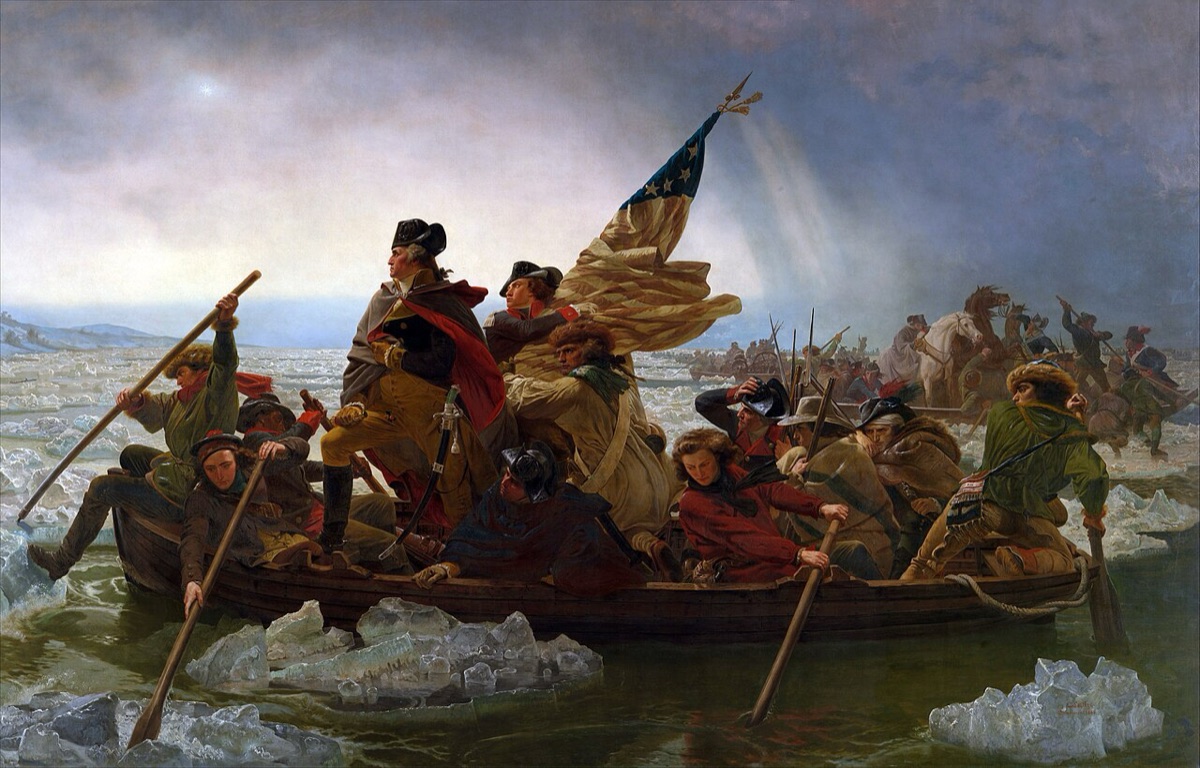
Washington Crossing the Delaware, by Emanuel Leutze, 1851.
- Washington stands near the front of a small rowboat, looking ahead, while soldiers row and push away chunks of ice.
- Behind him a man holds up the Stars and Stripes. An 1853 exhibition catalogue names him as Lieutenant James Monroe, the future president.
- The men in the boat are a mix: a man in a Scottish bonnet, a man of African descent, a rifleman in buckskin, farmers in wide hats, and a figure in Native American clothing. Leutze meant them to stand for all of the young country.
What is true
- The crossing really happened on a bitter winter night, and Knox wrote that floating ice made it the hardest part of the operation.
- The surprise worked: the Hessians at Trenton were not expecting an attack in the storm.
- Historian David Hackett Fischer argues the men may really have been standing, to keep out of the icy water in the bottom of the boats.
What was changed or invented
- The flag is wrong. The Stars and Stripes was only adopted by Congress on June 14, 1777, six months after the crossing.
- The boats were much bigger: flat-bottomed Durham boats about 40 to 60 feet long, plus ferries for the horses and cannon. A boat as small as the one in the painting could not have carried them.
- The crossing was made in the dark, starting around 6 p.m. Leutze lit Washington with a bright dawn sky to make him the hero of the picture.
- Leutze painted it in Düsseldorf, Germany, around 1850. The river in the background is modeled on the Rhine, not the Delaware.
Short timeline
- Nov 1776 · The British drive Washington's army out of New York.
- Dec 19, 1776 · Thomas Paine's The American Crisis appears: "These are the times that try men's souls."
- Dec 25, 1776 · Around 6 p.m. the army begins crossing at McConkey's Ferry in rain, sleet and snow.
- Dec 26, 1776 · The last cannon are across at 3 a.m.; that morning Washington wins at Trenton.
- Jan 2–3, 1777 · Washington wins again at Trenton and at Princeton, then goes into winter quarters.
- 1851 · Leutze's painting goes on show in New York; more than 50,000 people come to see it.
Talk about it: 3 questions
For the dinner table or the classroom.
- The flag in the painting did not exist yet in December 1776. Why do you think Leutze put it there anyway?
- Leutze filled the boat with men of very different backgrounds. What message was he sending, and how does it compare with who really served?
- Jonathan in The Fighting Ground expects war to be glorious. Does this painting show war the way Jonathan imagines it, or the way he finds it?
Also worth reading
Grades 4–10 · Boston Globe–Horn Book Award
The Notorious Benedict Arnoldby Steve Sheinkin
A fast true story of one of Washington's best generals, who later changed sides. Good for readers who want the real people behind the paintings.
Grades 6–8 · Alabama Camellia Children's Choice Book Award
The Thrifty Guide to the American Revolutionby Jonathan W. Stokes
A funny 'time-travel guidebook' to the Revolution for readers who find textbooks dry.
As an Amazon Associate, ReadingList earns from qualifying purchases at no extra cost to you. Grades come from the school, state and award lists in our database.
Where this fits in school
- AP US History reading list · Period 3 (1754–1800)
Sources
More history through paintings
- The fall of Troy and the wooden horse (legend) · Legend; Troy VIIa burned about 1180 BC
- The assassination of Julius Caesar · March 15, 44 BC
- Macbeth becomes King of Scotland · August 14, 1040
- Wat Tyler meets King Richard II at Smithfield (the Peasants' Revolt) · June 15, 1381
- Columbus lands on Guanahani (San Salvador) · October 12, 1492
- The baptism of Pocahontas · 1613–1614
- The Plymouth harvest feast of 1621 · Autumn 1621
- The Salem witch trials · 1692–1693
- The Battle of Bunker Hill · June 17, 1775
- New Yorkers pull down the king's statue after the Declaration of Independence · July 9, 1776
- The storming of the Bastille, start of the French Revolution · July 14, 1789
- The Lewis and Clark expedition reaches the Three Forks of the Missouri · July 1805
- The Underground Railroad in Indiana · 1826–1847
- The First Battle of Bull Run (First Manassas) · July 21, 1861
- Lincoln's first reading of the Emancipation Proclamation · July 22, 1862
- The Battle of Gettysburg and Pickett's Charge · July 1–3, 1863
- Settlers move west and the idea of manifest destiny · 1860s–1890s
- The sinking of the Titanic · April 14–15, 1912
- A mustard gas attack on the Western Front, World War I · August 1918
Last updated