Middle school · AP US History
The Battle of Bunker Hill: what the painting gets right
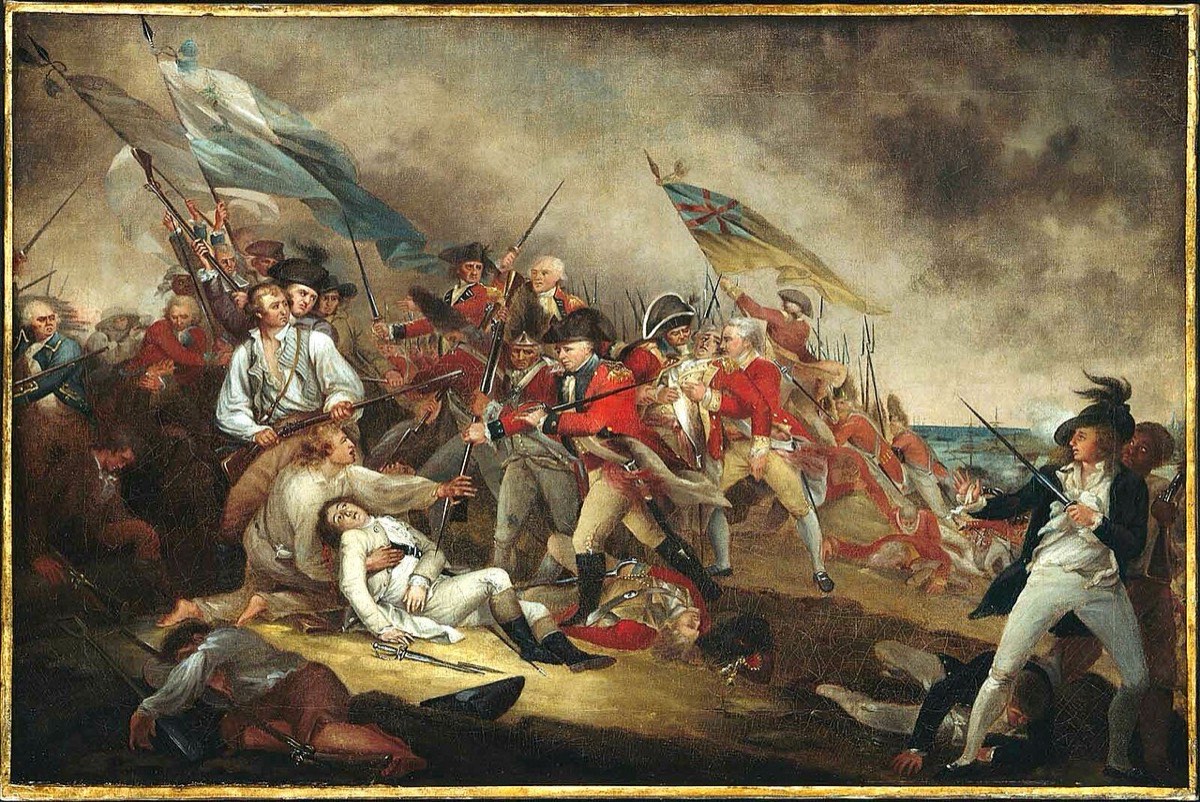
Your child is reading Johnny Tremain. Dr. Joseph Warren, one of the Boston patriots in the book, is the man dying at the center of this painting, two months after the story ends. Here is what really happened.
The book your child may be reading
Grades 3–7 · Newbery Medal winner, a staple of middle school American Revolution units
Johnny Tremainby Esther Hoskins Forbes
A silversmith's apprentice in Boston from 1773 to the battles of Lexington and Concord in 1775.
What really happened (June 17, 1775)
On the night of June 16, 1775, about 1,200 colonial troops built a redoubt on Breed's Hill, next to Bunker Hill, overlooking Boston. Most of the fighting the next day was on Breed's Hill, but the battle kept the Bunker Hill name.
British troops attacked three times. The first two assaults were driven back; on the third the colonists ran out of ammunition and the British took the redoubt.
The British won the ground but lost 1,054 men killed and wounded, about 40% of the force, including many officers. It showed that colonial militia could stand up to regular troops.
Joseph Warren, a Boston doctor and patriot leader who had sent Paul Revere on his midnight ride, had just been named a general. He chose to fight as a volunteer private and was killed when the British stormed the redoubt.
What the painting shows
The Death of General Warren at the Battle of Bunker's Hill, June 17, 1775, by John Trumbull, 1786.
- Warren, in white, lies dying at the center, held by a colonial soldier.
- A British officer, Major John Small, reaches out to stop a grenadier from bayoneting him.
- British and colonial flags, smoke, and the climax of the fight around the redoubt fill the background.
What is true
- Warren really did die in the last British assault on the redoubt.
- Major John Pitcairn, the British officer at Lexington, was really killed in this battle.
- Free Black soldiers, including Peter Salem and Salem Poor, really fought at Bunker Hill.
What was changed or invented
- Trumbull painted it in London eleven years later, as an allegory of the battle and of Warren's sacrifice, not as a picture of what anyone saw.
- The gentlemanly gesture of Major Small saving a dying enemy is a symbol. Small and Trumbull were friends, and the scene honors both sides.
- Many of the people in the painting, who fought in different parts of the field, are gathered into one heroic moment.
Short timeline
- Dec 1773 · Boston Tea Party (Johnny Tremain is set in Boston from 1773).
- Apr 18–19, 1775 · Warren sends Revere and Dawes to warn Lexington; fighting at Lexington and Concord.
- Jun 16, 1775 · Colonists fortify Breed's Hill overnight.
- Jun 17, 1775 · Three British assaults; the redoubt falls; Warren is killed.
- 1776 · Warren's body is identified by Paul Revere from an artificial tooth he had made.
Talk about it: 3 questions
For the dinner table or the classroom.
- Historians call this painting an allegory. What message did Trumbull want people to take from it, and how does the British officer's gesture help?
- The British won the battle. Why do Americans remember it as a moment of pride?
- Johnny Tremain shows Dr. Warren as a leader in Boston. How does knowing what happened to him two months later change how you read those scenes?
Also worth reading
Grades 5–9 · Scott O'Dell Award
Chainsby Laurie Halse Anderson
The Revolution seen by an enslaved girl in New York City in 1776, a year after Bunker Hill.
As an Amazon Associate, ReadingList earns from qualifying purchases at no extra cost to you. Grades come from the school, state and award lists in our database.
Where this fits in school
- AP US History reading list · Period 3 (1754–1800)