High school · AP US History
The Battle of Gettysburg and Pickett's Charge: what the painting gets right
Your child is reading The Killer Angels. Its last day ends with Pickett's Charge, the attack this print shows from the Union side. Here is what really happened on July 3, 1863.
The book your child may be reading
Grades 9–10 · Common Core lists, grades 9 and 10
The Killer Angelsby Michael Shaara
The 1975 Pulitzer Prize novel of the four days at Gettysburg, told by the commanders on both sides.
What really happened (July 1–3, 1863)
From July 1 to 3, 1863, Robert E. Lee's Army of Northern Virginia fought George Meade's Army of the Potomac around Gettysburg, Pennsylvania. Between 46,000 and 51,000 men were killed, wounded, captured or missing, the most of any battle in American history up to then.
On July 3 about 12,500 Confederate soldiers advanced across open fields toward the Union center on Cemetery Ridge. More than half became casualties.
The charge was planned for three divisions, under George Pickett, J. Johnston Pettigrew and Isaac Trimble, under James Longstreet's overall command. It is still called Pickett's Charge.
Lee retreated on July 4. His invasion of the North was over.
What the painting shows
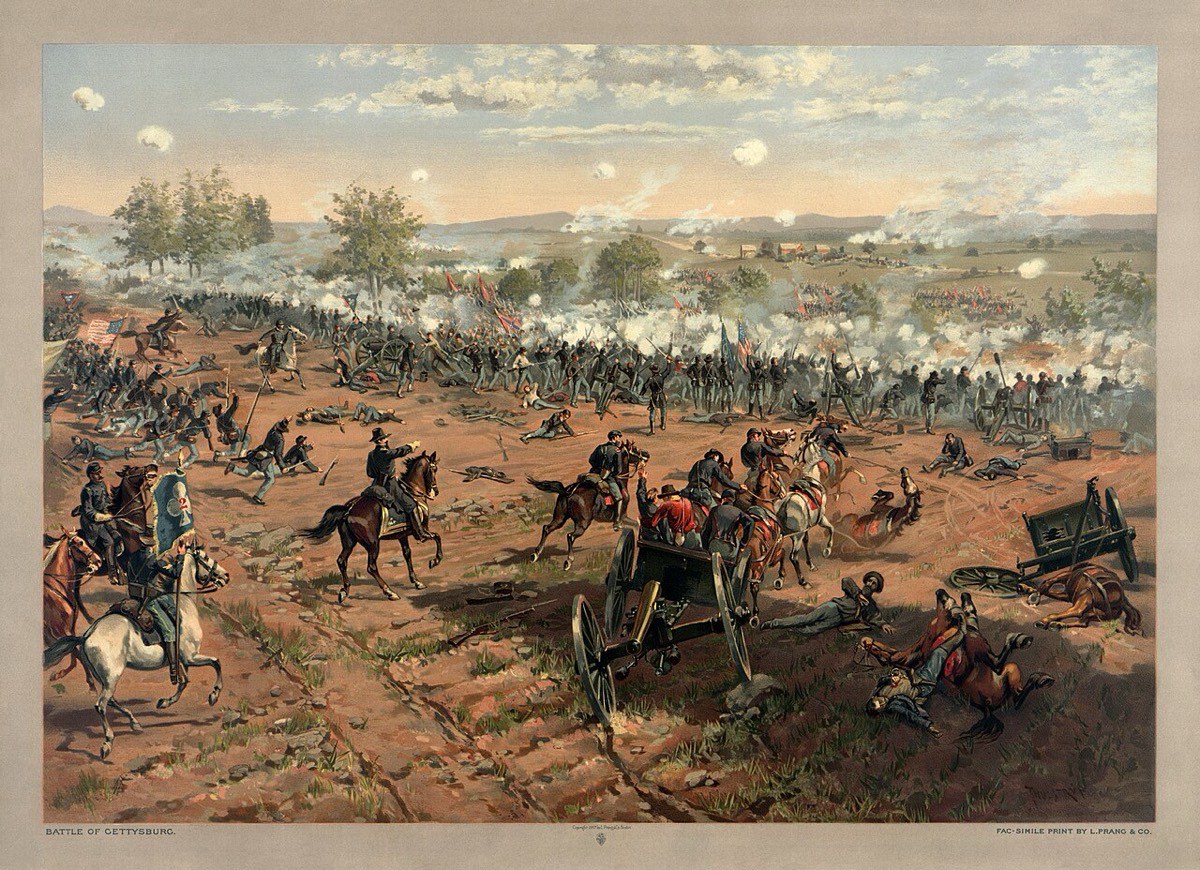
Battle of Gettysburg, by Thure de Thulstrup (L. Prang & Co.), 1887.
- Union officers on horseback and an artillery piece fill the foreground, looking toward the attack.
- Lines of Confederate infantry charge through smoke toward the Union position in the middle distance.
- Dead and wounded men and horses lie across the field.
What is true
- The view from the Union line toward the charge matches the ground of the third day.
- The Union commander there, Winfield Scott Hancock, really was on the field and was badly wounded during the charge.
What was changed or invented
- It was made in 1887, 24 years later, as a popular print. The bright colors and neat lines make a confused, smoky fight look orderly.
- The Library of Congress catalog record for this print mixes up Pickett and Hancock, a sign of how easily the people in such scenes get confused.
Short timeline
- Jun 29, 1863 · Armies move toward Gettysburg (where The Killer Angels begins).
- Jul 1, 1863 · Day 1: fighting west and north of town.
- Jul 2, 1863 · Day 2: Little Round Top and the Union left.
- Jul 3, 1863 · Day 3: Pickett's Charge fails.
- Nov 19, 1863 · Lincoln gives the Gettysburg Address.
Talk about it: 3 questions
For the dinner table or the classroom.
- The Killer Angels tells the battle through Lee, Longstreet and Chamberlain. Whose point of view does this print take, and what does it leave out?
- The charge had three commanders but carries Pickett's name. Why do you think one name stuck?
- Compare the neat lines in the print with how the novel describes the smoke and noise. Which feels closer to the truth, and why?
Also worth reading
Grades 4–10 · Golden Kite Award
The Long Road to Gettysburgby Jim Murphy
Nonfiction built on the diaries of two young soldiers, one on each side, for middle grade readers.
As an Amazon Associate, ReadingList earns from qualifying purchases at no extra cost to you. Grades come from the school, state and award lists in our database.
Where this fits in school
- AP US History reading list · Period 5 (1844–1877)