High school · AP US History
The Salem witch trials: what the painting gets right
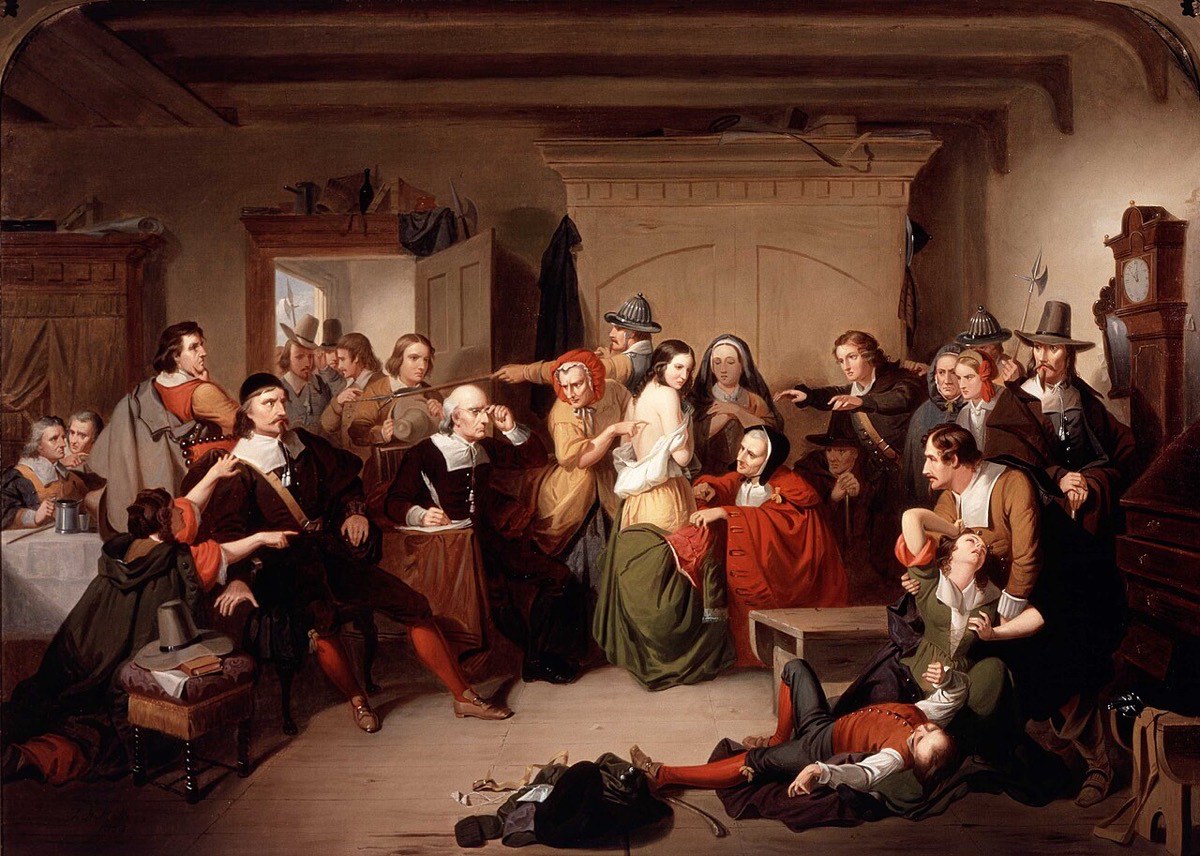
Your child is reading The Crucible. This painting shows the kind of scene Arthur Miller put on stage: an accused woman, a crowd of neighbors, and afflicted girls on the floor. Here is what really happened in Salem.
The book your child may be reading
Grades 10–12 · Common Core, IB English Literature and AP Literature lists, most often grade 11
The Crucibleby Arthur Miller
Miller's play about the trials, written as an allegory for the McCarthy hearings of the 1950s.
What really happened (1692–1693)
Between February 1692 and May 1693, more than 200 people in and around Salem, Massachusetts were accused of witchcraft. Nineteen were hanged, and one man, Giles Corey, was pressed to death with stones for refusing to enter a plea.
The accusations started with a group of girls whose fits were blamed on witches. Courts accepted 'spectral evidence', testimony that the accused person's spirit had attacked someone, which the accused could not disprove.
Physical searches of the accused for a 'witch's teat' or mark, a spot on the body supposedly used to feed a familiar spirit, were part of the process.
What the painting shows
Examination of a Witch, by Tompkins H. Matteson, 1853.
- A young woman with her dress pulled from her shoulders stands at the center while men and women point at her.
- On the right, a girl lies on the floor in a fit, held by a man, as the 'afflicted' girls did in the real hearings.
- A magistrate sits at a table on the left, writing down the examination.
What is true
- Bodily searches for a witch's mark really happened in 1692.
- Afflicted girls really did fall into fits during examinations, and their reactions were taken as evidence.
What was changed or invented
- Real searches were carried out in private by a group of women, not in front of a mixed crowd of men.
- Most of the accused were middle-aged or older women. Matteson made the accused young and beautiful, which turns the scene into a romantic drama.
- The painting was made in 1853, more than 160 years later. The room, clothes and faces are invented.
Short timeline
- Feb 1692 · Girls in Salem Village start having fits; the first three women are accused.
- Jun 1692 · Bridget Bishop is the first person hanged.
- Sep 1692 · Giles Corey is pressed to death; eight more people are hanged on Sept. 22.
- May 1693 · The governor pardons those still held; the trials end.
- 1953 · Arthur Miller's The Crucible opens on Broadway.
Talk about it: 3 questions
For the dinner table or the classroom.
- Matteson shows the accused as a young woman searched in public. Why might a painter in 1853 change those two facts?
- In The Crucible, Abigail Williams is 17. The real Abigail was 11 or 12. What does the play gain from the change, and what does it hide?
- Spectral evidence could not be checked by anyone but the accuser. Can you think of a modern situation where an accusation is hard to disprove?
Also worth reading
Grades 5–8 · Newbery Medal
The Witch of Blackbird Pondby Elizabeth George Speare
A younger read about a girl accused of witchcraft in Puritan Connecticut in 1687, five years before Salem.
As an Amazon Associate, ReadingList earns from qualifying purchases at no extra cost to you. Grades come from the school, state and award lists in our database.
Where this fits in school
- AP US History reading list · Period 2 (1607–1754)