High school · AP European History · AP World History
The storming of the Bastille, start of the French Revolution: what the painting gets right
Your child is reading A Tale of Two Cities. Dickens's Doctor Manette spent 18 years locked in the Bastille, and the Defarges lead the crowd that storms it. This watercolor was made the same year it happened. Here is what was really inside.
The book your child may be reading
Grades 9–12 · Common Core, IB English Literature and AP Literature lists, most often grade 11
A Tale of Two Citiesby Charles Dickens
Dickens's 1859 novel of London and Paris before and during the Revolution, with the storming of the Bastille at its center.
What really happened (July 14, 1789)
On July 14, 1789, a Paris crowd looking for gunpowder and weapons attacked the Bastille, a medieval fortress used as a royal prison. After about four hours of fighting, the governor, Bernard-René de Launay, surrendered.
Ninety-eight attackers and one defender died in the fighting or of their wounds. De Launay and several of the garrison were killed after they surrendered.
The Bastille was nearly empty. It held seven prisoners: four forgers, two mentally ill men, and a count locked up at his own family's request. It was already scheduled for demolition.
Its fall became the symbol of the Revolution, and July 14 is France's national day.
What the painting shows
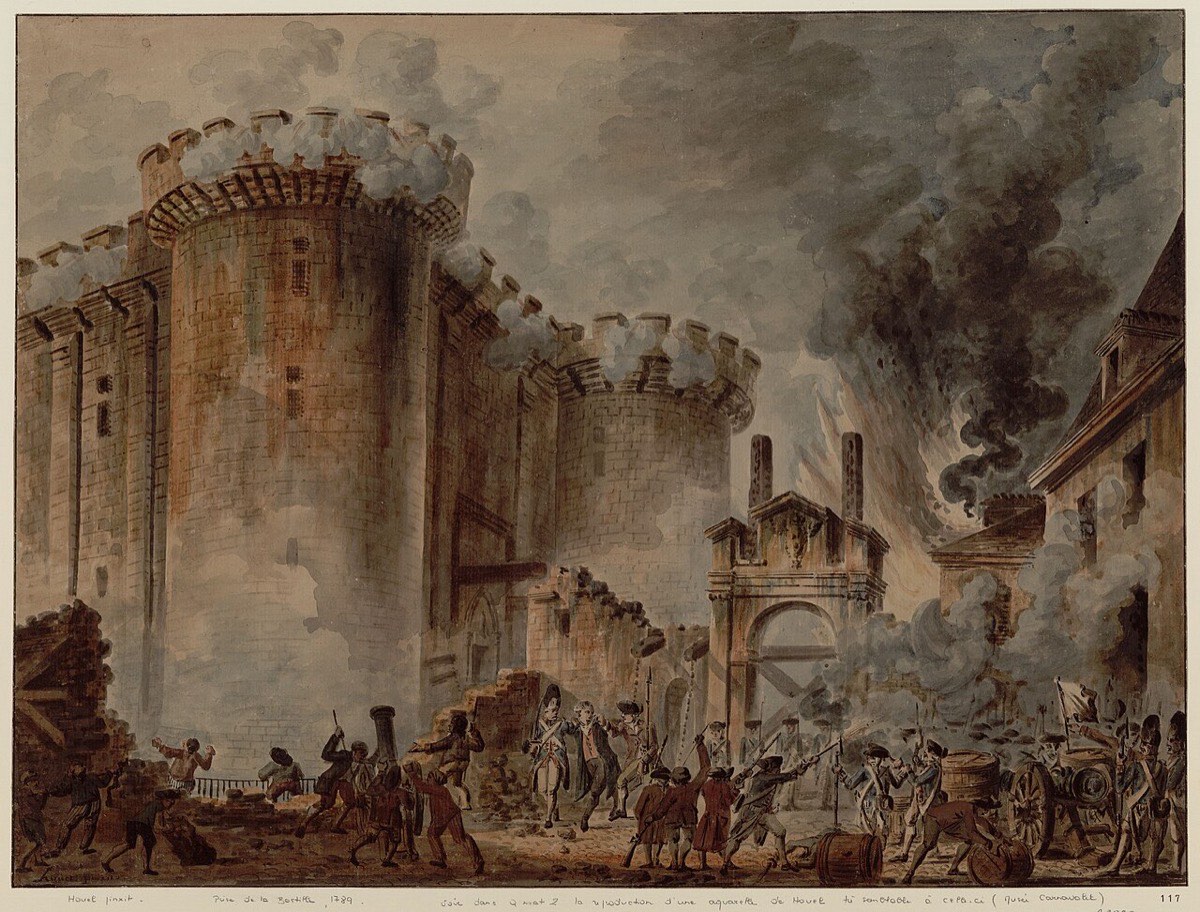
Prise de la Bastille (The Storming of the Bastille), by Jean-Pierre Houël, 1789.
- The huge round towers of the Bastille rise above clouds of gun smoke.
- A building burns on the right.
- At the center, at the foot of the walls, attackers seize a man: the arrest of the governor, de Launay.
What is true
- Houël made it in 1789, the year of the event, and the fortress's shape and scale match the real building.
- The governor really was seized by the crowd after the surrender.
What was changed or invented
- Several moments of a four-hour fight are folded into one scene: the smoke, the fire and the arrest did not all happen at once.
- Like most images of the day, it shows the triumph, not the killing of de Launay and the garrison that followed.
Short timeline
- May 1789 · The Estates-General meets at Versailles.
- Jun 20, 1789 · The Tennis Court Oath.
- Jul 14, 1789 · The Bastille is stormed; de Launay is killed.
- 1793–1794 · The Reign of Terror, the setting of the end of A Tale of Two Cities.
- 1859 · Dickens publishes A Tale of Two Cities.
Talk about it: 3 questions
For the dinner table or the classroom.
- The Bastille held only seven prisoners. Why did taking it still matter so much to people in 1789?
- Dickens invented Doctor Manette's 18 years in the Bastille. What does the novel gain from a prisoner like him that the real, nearly empty prison could not give?
- Houël left out the killing of the governor after he surrendered. Is leaving something out the same as changing it?
Also worth reading
High school
The Scarlet Pimpernelby Baroness Orczy
An English hero rescues aristocrats from the guillotine during the Terror; a lighter companion to Dickens.
As an Amazon Associate, ReadingList earns from qualifying purchases at no extra cost to you. Grades come from the school, state and award lists in our database.
Where this fits in school
- AP European History reading list · Unit 5 (1648–1815)
- AP World History reading list · Unit 5: Revolutions (1750–1900)