High school · AP European History · AP World History
A mustard gas attack on the Western Front, World War I: what the painting gets right
Your child is reading All Quiet on the Western Front. Paul Bäumer's gas attack is one of the book's most frightening scenes. Sargent saw the aftermath of one in 1918 and painted it 20 feet wide. Here is what he saw, and what he arranged.
The book your child may be reading
Grades 9–12 · Common Core lists, grade 10
All Quiet on the Western Frontby Erich Maria Remarque
A young German soldier's war, written by a veteran of the Western Front.
What really happened (August 1918)
Mustard gas, first used by Germany in 1917, burned skin, lungs and eyes. Many soldiers were blinded for days or weeks; most of them recovered their sight.
The British War Memorials Committee sent the American painter John Singer Sargent to the Western Front in July 1918 to paint the war.
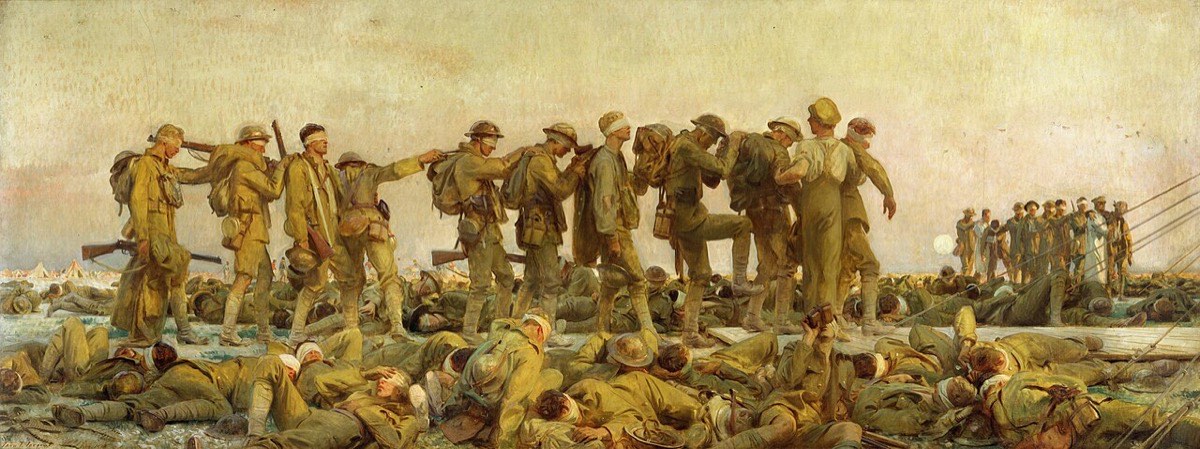
On August 21, 1918, at Le Bac-du-Sud near Arras, he saw the aftermath of a German barrage: gassed men being led to a dressing station.
He finished the painting, 6.1 meters (20 feet) wide, in March 1919. It was voted picture of the year at the Royal Academy that summer and hangs in the Imperial War Museum in London.
What the painting shows
Gassed, by John Singer Sargent, 1919.
- Eleven nearly life-size soldiers, most with bandaged eyes, walk in a line along a duckboard, each holding the shoulder of the man in front.
- Dozens of gassed men lie on the ground around them.
- In the background, men play football and biplanes fight in the evening sky.
What is true
- Sargent saw this kind of scene himself, at a real dressing station near Arras.
- Gassed men really were led in lines with their eyes bandaged.
- The football game is not an invention for effect; life went on beside the wounded behind the lines.
What was changed or invented
- The tall, clean, golden-lit soldiers are arranged like a classical frieze or a religious procession, which makes the suffering look calm and dignified.
- The men are British. All Quiet on the Western Front is told by a German soldier, from the other side of the same front.
Short timeline
- 1914 · War begins; the Western Front settles into trenches.
- Apr 1915 · First large chlorine gas attack, at Ypres.
- Jul 1917 · Germany first uses mustard gas.
- Aug 21, 1918 · Sargent sees gassed soldiers near Arras.
- Nov 11, 1918 · Armistice.
- 1928–1929 · All Quiet on the Western Front is published.
Talk about it: 3 questions
For the dinner table or the classroom.
- Sargent was paid by a British war memorials committee. How might that shape what he chose to show?
- Remarque's soldiers are German, Sargent's are British. What do the two sides of the front have in common in the book and the painting?
- Why do you think Sargent put a football game in the background?
Also worth reading
Grades 9–12
Private Peacefulby Michael Morpurgo
Two English brothers in the trenches; shorter and gentler, a good first World War I novel.
Grades 11–12
A Farewell to Armsby Ernest Hemingway
Hemingway's novel of an American ambulance driver on the Italian front.
As an Amazon Associate, ReadingList earns from qualifying purchases at no extra cost to you. Grades come from the school, state and award lists in our database.
Where this fits in school
- AP European History reading list · Unit 8 (c. 1914–present)
- AP World History reading list · Unit 7: Global Conflict (1900–present)