Middle school
The fall of Troy and the wooden horse (legend): what the painting gets right
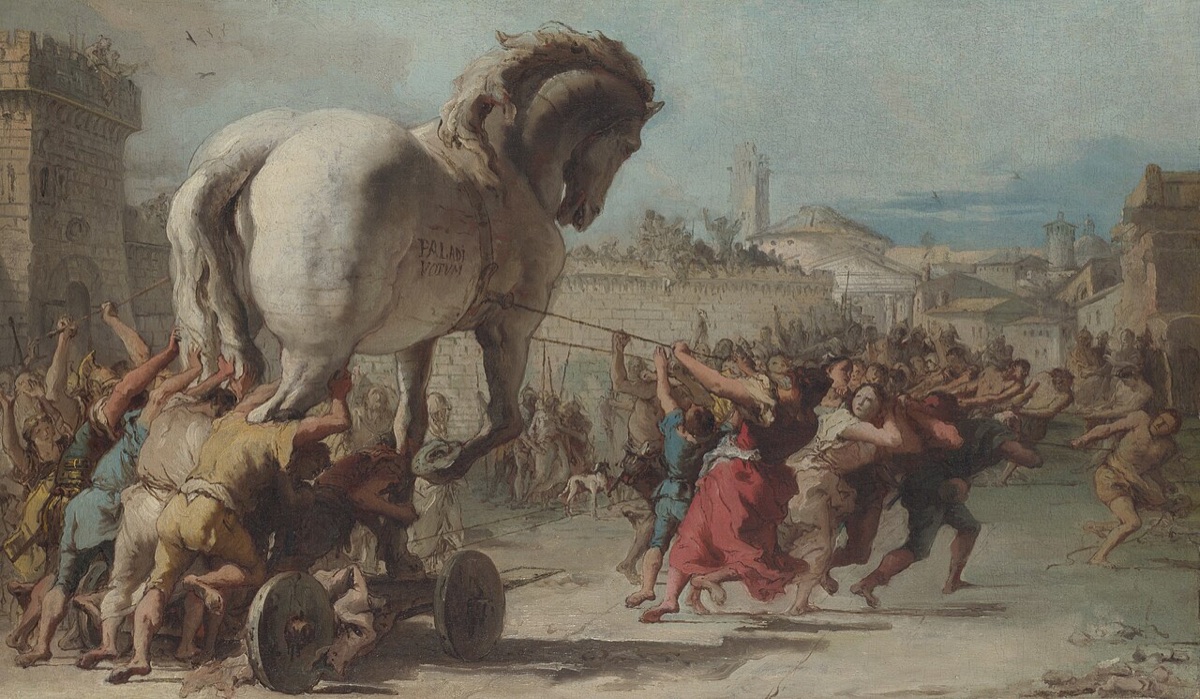
Your child is reading Black Ships Before Troy. Rosemary Sutcliff retells the whole Trojan War, all the way to the wooden horse. This painting shows the Trojans pulling that horse into their own city. Here is what is legend, and what archaeologists have found.
The book your child may be reading
Grades 6–8 · Common Core lists, grades 6 to 8
Black Ships Before Troyby Rosemary Sutcliff
The whole Trojan War in short chapters, from the golden apple to the wooden horse, told in strong, clear prose.
What really happened (Legend; Troy VIIa burned about 1180 BC)
Troy was a real city in what is now northwest Turkey, at a site called Hisarlık. It was settled for about 4,000 years and rebuilt again and again, leaving nine layers of ruins.
In the Late Bronze Age the city was called Wilusa and was a vassal of the Hittite Empire. One layer, known as Troy VIIa, ended around 1180 BC.
Frank Calvert and Heinrich Schliemann began digging there in 1871. Some layers look like the Troy of the poems, so some scholars think there is a kernel of truth in the legend. But no clear evidence of a Greek attack has been found.
The wooden horse is not in the Iliad at all, which ends before Troy falls. It is mentioned briefly in the Odyssey and told in full by the Roman poet Virgil in the Aeneid, written around 19 BC, more than a thousand years after the city burned.
What the painting shows
The Procession of the Trojan Horse in Troy, by Giovanni Domenico Tiepolo, about 1760.
- A huge white horse stands on a wheeled platform. Trojans pull it forward with long ropes, while others push from behind.
- A woman in a red dress and a crowd of men lean into the ropes, heading toward the city.
- Stone walls, towers and domed buildings rise in the background.
What is true
- It follows the story as Virgil tells it: the Trojans themselves dragged the horse inside as a trophy, thinking the Greeks had sailed away.
- The size is right for the legend too. In Virgil, the Greek spy Sinon tells the Trojans the horse was built too large for them to take into their city.
What was changed or invented
- There is no evidence the horse ever existed. It is a story told by poets, and the fullest version is Roman, written over a thousand years after Troy burned.
- The city behind looks like an Italian town of Tiepolo's own time, with domes and bell towers. Bronze Age Troy had walls and towers, but nothing like these buildings.
- Tiepolo painted it around 1760 as a busy, cheerful crowd scene. In the Aeneid the moment is full of warnings: the priest Laocoön and the princess Cassandra both said the horse would destroy them.
Short timeline
- About 3600 BC · People first settle at the site of Troy.
- About 1300–1180 BC · Troy VIIa, the layer many link to the legend, stands and then ends.
- 800s–500s BC · The Iliad and the Odyssey are composed, sometime in this span.
- About 19 BC · Virgil writes the Aeneid, with the full story of the wooden horse.
- 1871 · Calvert and Schliemann begin digging at Hisarlık.
Talk about it: 3 questions
For the dinner table or the classroom.
- Black Ships Before Troy is a retelling of a retelling. How many steps are there between what really happened at Troy and the book in your hands?
- Laocoön warned, "I fear Greeks, even those bearing gifts." Why didn't the Trojans listen?
- Archaeologists found a real city that burned, but no horse. Does that make the story true, false, or something in between?
Also worth reading
Grades 9–12 · Common Core lists, grades 9 and 10
The Odysseyby Homer
What happened after Troy fell: Odysseus, who thought up the horse, spends ten years getting home.
As an Amazon Associate, ReadingList earns from qualifying purchases at no extra cost to you. Grades come from the school, state and award lists in our database.
Sources
More history through paintings
- The assassination of Julius Caesar · March 15, 44 BC
- Macbeth becomes King of Scotland · August 14, 1040
- Wat Tyler meets King Richard II at Smithfield (the Peasants' Revolt) · June 15, 1381
- Columbus lands on Guanahani (San Salvador) · October 12, 1492
- The baptism of Pocahontas · 1613–1614
- The Plymouth harvest feast of 1621 · Autumn 1621
- The Salem witch trials · 1692–1693
- The Battle of Bunker Hill · June 17, 1775
- Washington crosses the Delaware and wins at Trenton · December 25–26, 1776
- New Yorkers pull down the king's statue after the Declaration of Independence · July 9, 1776
- The storming of the Bastille, start of the French Revolution · July 14, 1789
- The Lewis and Clark expedition reaches the Three Forks of the Missouri · July 1805
- The Underground Railroad in Indiana · 1826–1847
- The First Battle of Bull Run (First Manassas) · July 21, 1861
- Lincoln's first reading of the Emancipation Proclamation · July 22, 1862
- The Battle of Gettysburg and Pickett's Charge · July 1–3, 1863
- Settlers move west and the idea of manifest destiny · 1860s–1890s
- The sinking of the Titanic · April 14–15, 1912
- A mustard gas attack on the Western Front, World War I · August 1918
Last updated