High school
Macbeth becomes King of Scotland: what the painting gets right
Your child is reading Macbeth. Shakespeare's Macbeth is a murderer driven by witches and a ruthless wife. The real Macbeth was a king of Scotland who ruled for 17 years. This painting shows the moment the play's story begins. Here is what is history and what is invented.
The book your child may be reading
Grades 9–12 · AQA GCSE set text, Common Core lists (grade 10), AP Literature and IB English Literature
Macbethby William Shakespeare
A Scottish general, spurred by three witches and his wife, kills the king and is destroyed by guilt. Shakespeare's shortest tragedy.
What really happened (August 14, 1040)
Macbeth was a real ruler, the Mormaer (earl) of Moray in northern Scotland from 1032.
King Duncan I, who was a young man and not the old king of the play, led an army into Moray in 1040. He was killed in battle by Macbeth's men near Elgin, probably on August 14, 1040.
Macbeth became king with little opposition and ruled for 17 years, mostly in peace. In 1050 he made a pilgrimage to Rome, where, a chronicler wrote, he gave money to the poor as if it were seed.
In 1057 he was killed in battle at Lumphanan by forces loyal to Duncan's son, the future Malcolm III, whose descendants went on to rule Scotland.
What the painting shows
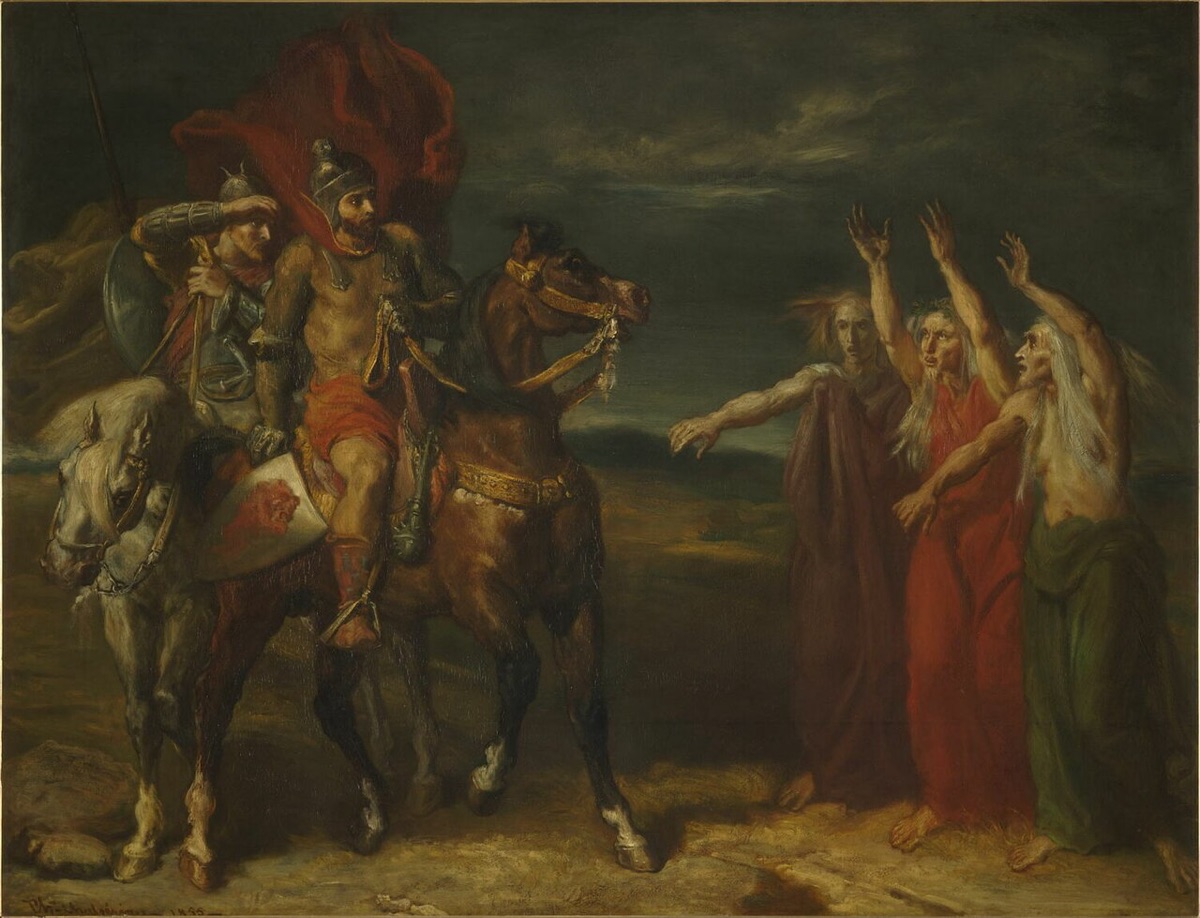
Macbeth and the Three Witches, by Théodore Chassériau, 1855.
- On the left, two armoured riders rein in their horses on a dark heath, one under a billowing red cloak: Macbeth and Banquo coming home from battle.
- On the right, three old women with wild grey hair raise their arms toward the sky, and one points straight at the riders.
- The sky is stormy and the ground is bare, as in the play's opening.
What is true
- Macbeth was real, he was a war leader, and he did become king after Duncan died at the hands of his men.
- The scene follows the play closely: in Act 1, Macbeth and Banquo meet the witches on a heath after a battle, and the witches hail Macbeth as the future king.
What was changed or invented
- No medieval account mentions the witches, Banquo or Lady Macbeth. They first appear in 1527 in a history by Hector Boece, who wanted to make Macbeth look bad and strengthen the Stuart family's claim to the throne. Boece made Banquo an ancestor of the Stuart kings. The real Macbeth did have a wife, Gruoch, but no early record makes her a schemer.
- Duncan was killed in battle, not murdered in bed as a guest, and Macbeth ruled for 17 years, not a few bloody months.
- Shakespeare took the story from Holinshed's Chronicles and wrote the play around 1606, under King James, who was thought to descend from Banquo. Chassériau painted the play's scene in 1855, more than 800 years after the real events.
Short timeline
- 1032 · Macbeth becomes Mormaer of Moray.
- Aug 14, 1040 · Duncan I is killed in battle near Elgin; Macbeth becomes king.
- 1050 · Macbeth makes a pilgrimage to Rome.
- 1057 · Macbeth is killed at the Battle of Lumphanan.
- 1527 · Hector Boece's history adds the witches, Banquo and Lady Macbeth's role.
- About 1606 · Shakespeare's Macbeth is first performed.
Talk about it: 3 questions
For the dinner table or the classroom.
- The real Macbeth ruled for 17 years and went on a pilgrimage to Rome. Why would a writer in 1527 want to turn him into a murderer?
- Shakespeare wrote under a king who was thought to be descended from Banquo. How does that change how you read Banquo in the play?
- The painter shows the witches pointing straight at Macbeth. Did the witches make him a murderer, or did they only say what he already wanted?
As an Amazon Associate, ReadingList earns from qualifying purchases at no extra cost to you. Grades come from the school, state and award lists in our database.
Sources
More history through paintings
- The fall of Troy and the wooden horse (legend) · Legend; Troy VIIa burned about 1180 BC
- The assassination of Julius Caesar · March 15, 44 BC
- Wat Tyler meets King Richard II at Smithfield (the Peasants' Revolt) · June 15, 1381
- Columbus lands on Guanahani (San Salvador) · October 12, 1492
- The baptism of Pocahontas · 1613–1614
- The Plymouth harvest feast of 1621 · Autumn 1621
- The Salem witch trials · 1692–1693
- The Battle of Bunker Hill · June 17, 1775
- Washington crosses the Delaware and wins at Trenton · December 25–26, 1776
- New Yorkers pull down the king's statue after the Declaration of Independence · July 9, 1776
- The storming of the Bastille, start of the French Revolution · July 14, 1789
- The Lewis and Clark expedition reaches the Three Forks of the Missouri · July 1805
- The Underground Railroad in Indiana · 1826–1847
- The First Battle of Bull Run (First Manassas) · July 21, 1861
- Lincoln's first reading of the Emancipation Proclamation · July 22, 1862
- The Battle of Gettysburg and Pickett's Charge · July 1–3, 1863
- Settlers move west and the idea of manifest destiny · 1860s–1890s
- The sinking of the Titanic · April 14–15, 1912
- A mustard gas attack on the Western Front, World War I · August 1918
Last updated