Middle school · AP US History · AP World History
Columbus lands on Guanahani (San Salvador): what the painting gets right
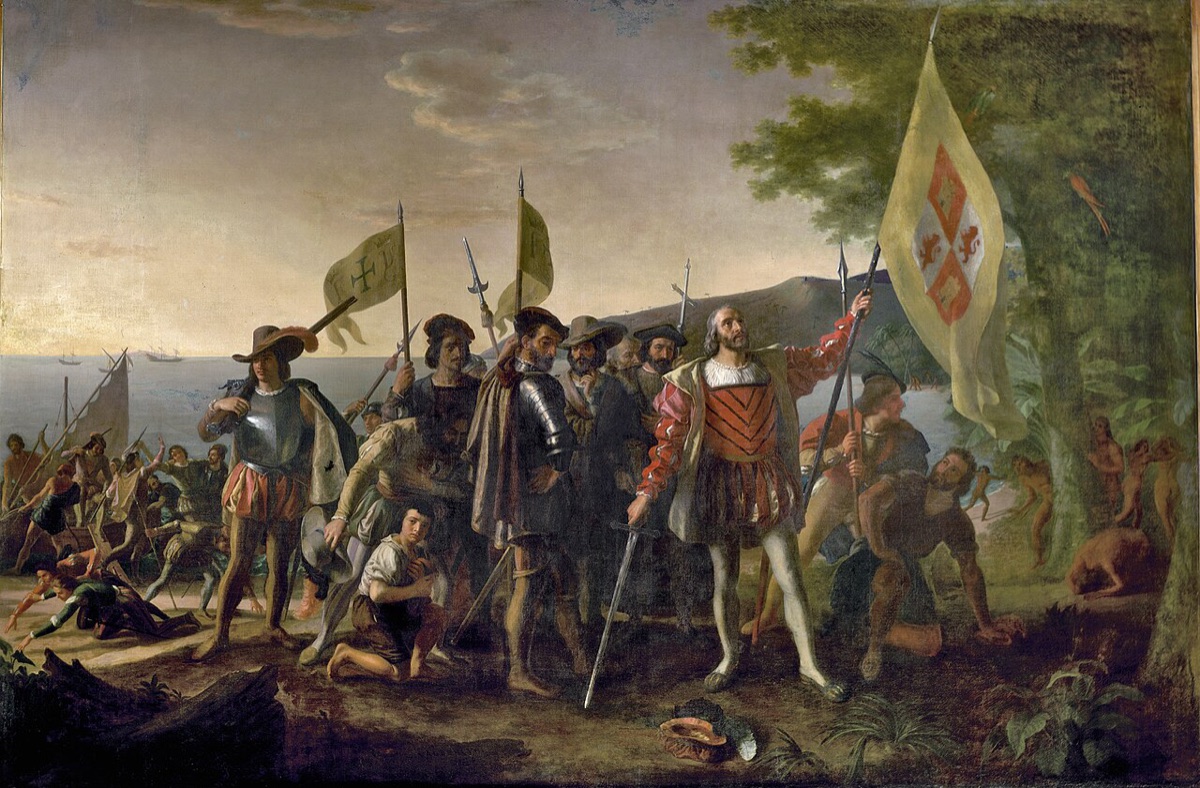
Your child is reading Morning Girl. Michael Dorris tells the story of a Taíno girl and her brother on their island, and the book ends on the morning strangers arrive in boats. This painting hangs in the U.S. Capitol and shows that same morning from the other side. Here is what really happened.
The book your child may be reading
Grades 4–7 · Scott O'Dell Award for Historical Fiction
Morning Girlby Michael Dorris
Morning Girl and her brother Star Boy take turns telling about life on their island in 1492, until she sees the first Europeans arrive.
What really happened (October 12, 1492)
Columbus's three ships had been out of sight of land for weeks when, early on October 12, 1492, a sailor on the Pinta named Rodrigo de Triana saw land. Columbus later claimed he had seen a light first, and took the reward that had been promised to whoever sighted land.
That morning Columbus went ashore with a royal flag. His two captains carried banners with a green cross and the letters F and Y, for King Ferdinand and Queen Isabel of Spain, who had paid for the voyage.
The island's people, Lucayans, called it Guanahaní. Columbus renamed it San Salvador. Nobody is sure which island in the Bahamas it was; the one named San Salvador today got that name only in 1925.
Columbus believed he had reached the Indies near Asia, so he called the people "Indians." In his account he wrote that they would make good servants. He noticed their gold ear ornaments and took some of them captive to guide him to the source of the gold.
What the painting shows
Landing of Columbus, by John Vanderlyn, 1847.
- Columbus stands in the middle in a red tunic, bareheaded, holding a sword in one hand and raising a pole with a royal banner of Castile in the other.
- His officers and soldiers crowd behind him with more banners and spears. One man kneels at his side.
- On the left, sailors run along the beach and bend over the sand. On the right, island people watch from behind the trees, some bowing low.
What is true
- Columbus did go ashore that morning carrying a royal flag, and his captains did carry banners for Ferdinand and Isabel.
- The sailors searching the sand fit Columbus's own account: he noticed the islanders' gold ear ornaments and pressed captives to lead him to the source of the gold.
What was changed or invented
- The banner is a guess. Columbus's account does not describe the flag. The usual picture shows the banner of Castile, but the royal flag of Ferdinand and Isabel carried the arms of both Castile and Aragon.
- Vanderlyn painted it in 1847, 355 years later, for the Capitol in Washington. He made it a calm, almost holy moment, with Columbus bareheaded and his hat at his feet. Nobody who was there painted the scene.
- The islanders hide and bow at the edges, small and in shadow. They are the people Morning Girl is about, and the painting gives them no faces and no voice.
Short timeline
- Aug 3, 1492 · Columbus sails from Spain with three ships.
- Oct 10, 1492 · Columbus calms a near-mutiny by sailors who want to turn back.
- Oct 12, 1492, before dawn · Rodrigo de Triana sights land from the Pinta.
- Oct 12, 1492, morning · Columbus lands on Guanahaní and claims it for Spain as San Salvador.
- 1847 · Vanderlyn's painting is installed in the U.S. Capitol Rotunda.
Talk about it: 3 questions
For the dinner table or the classroom.
- Morning Girl ends with her welcoming the strangers. Knowing what Columbus wrote about her people that same week, how does that ending feel?
- The painter put Columbus in the light and the islanders in the shadows. Why would a painting for the U.S. Capitol in 1847 be arranged that way?
- Columbus took the reward for seeing land first, even though a sailor saw it. What does that tell you about whose version of a story gets remembered?
Also worth reading
Elementary school
Encounterby Jane Yolen
A picture book in which a Taíno boy watches Columbus land and does not trust the strangers, the same morning seen by a younger child.
As an Amazon Associate, ReadingList earns from qualifying purchases at no extra cost to you. Grades come from the school, state and award lists in our database.
Where this fits in school
- AP US History reading list · Period 1 (1491–1607)
- AP World History reading list · Unit 4: Transoceanic Interconnections (1450–1750)
Sources
More history through paintings
- The fall of Troy and the wooden horse (legend) · Legend; Troy VIIa burned about 1180 BC
- The assassination of Julius Caesar · March 15, 44 BC
- Macbeth becomes King of Scotland · August 14, 1040
- Wat Tyler meets King Richard II at Smithfield (the Peasants' Revolt) · June 15, 1381
- The baptism of Pocahontas · 1613–1614
- The Plymouth harvest feast of 1621 · Autumn 1621
- The Salem witch trials · 1692–1693
- The Battle of Bunker Hill · June 17, 1775
- Washington crosses the Delaware and wins at Trenton · December 25–26, 1776
- New Yorkers pull down the king's statue after the Declaration of Independence · July 9, 1776
- The storming of the Bastille, start of the French Revolution · July 14, 1789
- The Lewis and Clark expedition reaches the Three Forks of the Missouri · July 1805
- The Underground Railroad in Indiana · 1826–1847
- The First Battle of Bull Run (First Manassas) · July 21, 1861
- Lincoln's first reading of the Emancipation Proclamation · July 22, 1862
- The Battle of Gettysburg and Pickett's Charge · July 1–3, 1863
- Settlers move west and the idea of manifest destiny · 1860s–1890s
- The sinking of the Titanic · April 14–15, 1912
- A mustard gas attack on the Western Front, World War I · August 1918
Last updated