Middle school · AP US History
The First Battle of Bull Run (First Manassas): what the painting gets right
Your child is reading Bull Run. Paul Fleischman tells the first big battle of the Civil War through 16 voices, Northern and Southern. This colorful print, made 28 years later, shows the same fight as a neat cavalry charge. Here is what really happened.
The book your child may be reading
Grades 5–8 · Scott O'Dell Award for Historical Fiction
Bull Runby Paul Fleischman
Sixteen short monologues by Northerners and Southerners, from generals to a drummer boy and a worried sister, all about this one battle.
What really happened (July 21, 1861)
On July 21, 1861, three months after the war began at Fort Sumter, a Union army under General Irvin McDowell attacked Confederate forces near Manassas Junction, Virginia, about 30 miles from Washington. Northern newspapers and politicians had pushed for a quick march on Richmond.
Both armies were new and poorly trained; each side got about 18,000 men into the fight. The Union attack went well at first, but Confederate reinforcements arrived from the Shenandoah Valley by railroad.
A Virginia brigade under Thomas J. Jackson held its ground on Henry House Hill, which earned him the nickname "Stonewall." A Confederate counterattack turned the Union withdrawal into a panicked run back toward Washington.
Wealthy people from Washington, including members of Congress, had come out with picnics to watch, expecting an easy win. Their carriages blocked the roads during the retreat. About 460 Union and 387 Confederate soldiers were killed, the bloodiest battle in American history up to that day.
What the painting shows
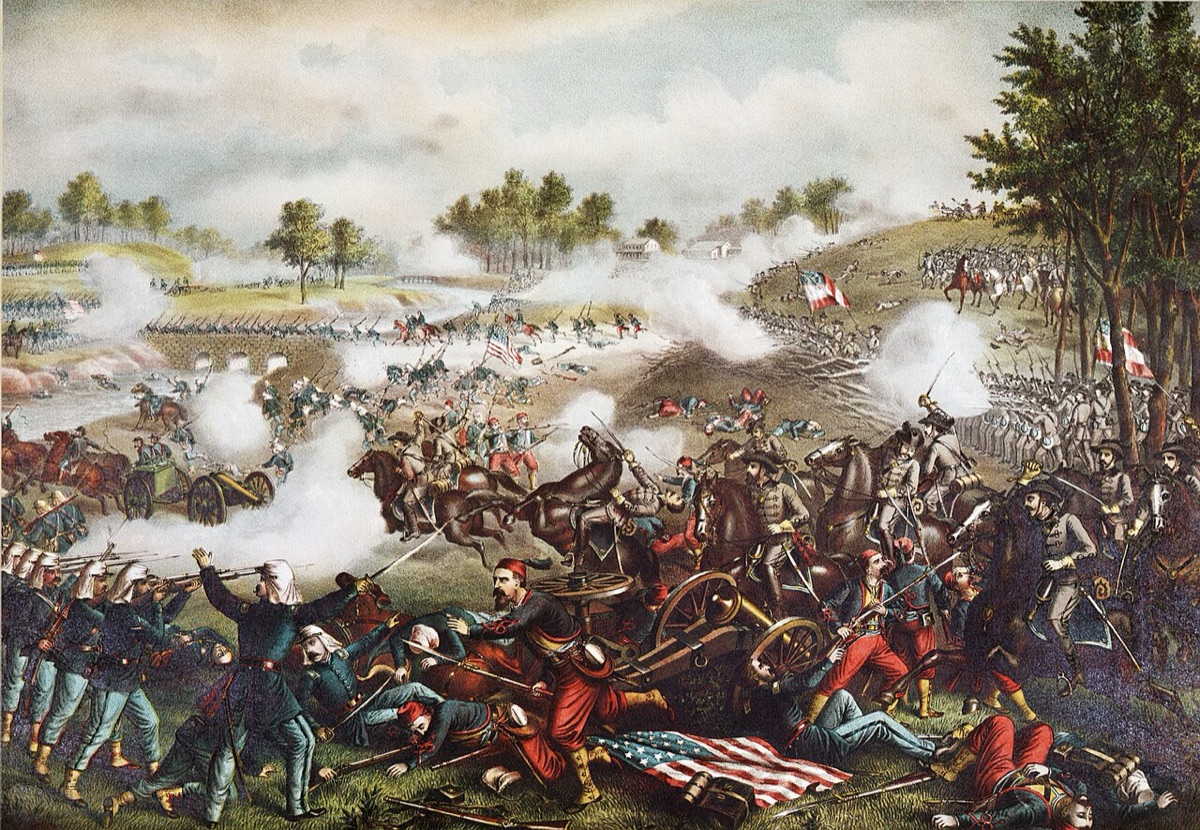
Battle of Bull Run, by Kurz & Allison, 1889.
- In the front, Confederate cavalry ride into a line of Union soldiers. Several of the Union men wear red trousers and fezzes, the uniform of Zouave regiments.
- A cannon stands among the fighting, and an American flag lies on the ground.
- Behind, lines of troops, smoke and more horsemen spread across green hills under a pale sky.
What is true
- Zouaves really were there: the 11th New York, known as Ellsworth's Fire Zouaves, was guarding Union cannon when Confederate cavalry under J.E.B. Stuart hit its flank and scattered it.
- Union guns really were overrun and captured during the fighting on Henry House Hill.
What was changed or invented
- Uniforms were not as tidy as the print suggests. In 1861 many regiments still wore their own outfits: the 33rd Virginia, a Confederate regiment, wore blue, and a Union officer ordered his gunners not to fire on it because he took it for his own side.
- The print shows a clean, colorful charge. It leaves out the part most people remembered: the Union army's disorderly flight and the civilians who had come to watch.
- Kurz & Allison made it in 1889, 28 years later, as a popular print to sell. It is a picture of how people liked to remember the war, not a record of one moment.
Short timeline
- Apr 12, 1861 · Confederate guns fire on Fort Sumter; the Civil War begins.
- Jul 16, 1861 · McDowell's army marches out of Washington toward Manassas.
- Jul 21, 1861, morning · The Union attack pushes back the Confederate left.
- Jul 21, 1861, afternoon · Jackson's brigade holds Henry House Hill; Confederate reinforcements arrive by rail; the Union retreat becomes a rout.
- 1889 · Kurz & Allison publish their print of the battle.
Talk about it: 3 questions
For the dinner table or the classroom.
- Bull Run is told by 16 different people. Which of their points of view does this print show, and which does it leave out?
- People from Washington brought picnics to watch the battle. What does that tell you about what Americans expected the war to be like in 1861?
- A Union officer told his gunners not to fire because the 33rd Virginia wore blue. Why would matching uniforms matter so much on a battlefield?
Also worth reading
Grades 4–8 · Maine Student Book Award and Alabama Camellia Children's Choice Book Award
Pink and Sayby Patricia Polacco
A picture book about two Union soldiers, one white and one Black, captured by Southern troops. Based on the author's family story.
Grades 5–8 · Scott O'Dell Award for Historical Fiction
Charley Skedaddleby Patricia Beatty
A 12-year-old New York drummer boy runs from a battle in Virginia and has to live with it, a good match for Bull Run's retreat.
As an Amazon Associate, ReadingList earns from qualifying purchases at no extra cost to you. Grades come from the school, state and award lists in our database.
Where this fits in school
- AP US History reading list · Period 5 (1844–1877)
Sources
More history through paintings
- The fall of Troy and the wooden horse (legend) · Legend; Troy VIIa burned about 1180 BC
- The assassination of Julius Caesar · March 15, 44 BC
- Macbeth becomes King of Scotland · August 14, 1040
- Wat Tyler meets King Richard II at Smithfield (the Peasants' Revolt) · June 15, 1381
- Columbus lands on Guanahani (San Salvador) · October 12, 1492
- The baptism of Pocahontas · 1613–1614
- The Plymouth harvest feast of 1621 · Autumn 1621
- The Salem witch trials · 1692–1693
- The Battle of Bunker Hill · June 17, 1775
- Washington crosses the Delaware and wins at Trenton · December 25–26, 1776
- New Yorkers pull down the king's statue after the Declaration of Independence · July 9, 1776
- The storming of the Bastille, start of the French Revolution · July 14, 1789
- The Lewis and Clark expedition reaches the Three Forks of the Missouri · July 1805
- The Underground Railroad in Indiana · 1826–1847
- Lincoln's first reading of the Emancipation Proclamation · July 22, 1862
- The Battle of Gettysburg and Pickett's Charge · July 1–3, 1863
- Settlers move west and the idea of manifest destiny · 1860s–1890s
- The sinking of the Titanic · April 14–15, 1912
- A mustard gas attack on the Western Front, World War I · August 1918
Last updated