Middle school · AP US History
New Yorkers pull down the king's statue after the Declaration of Independence: what the painting gets right
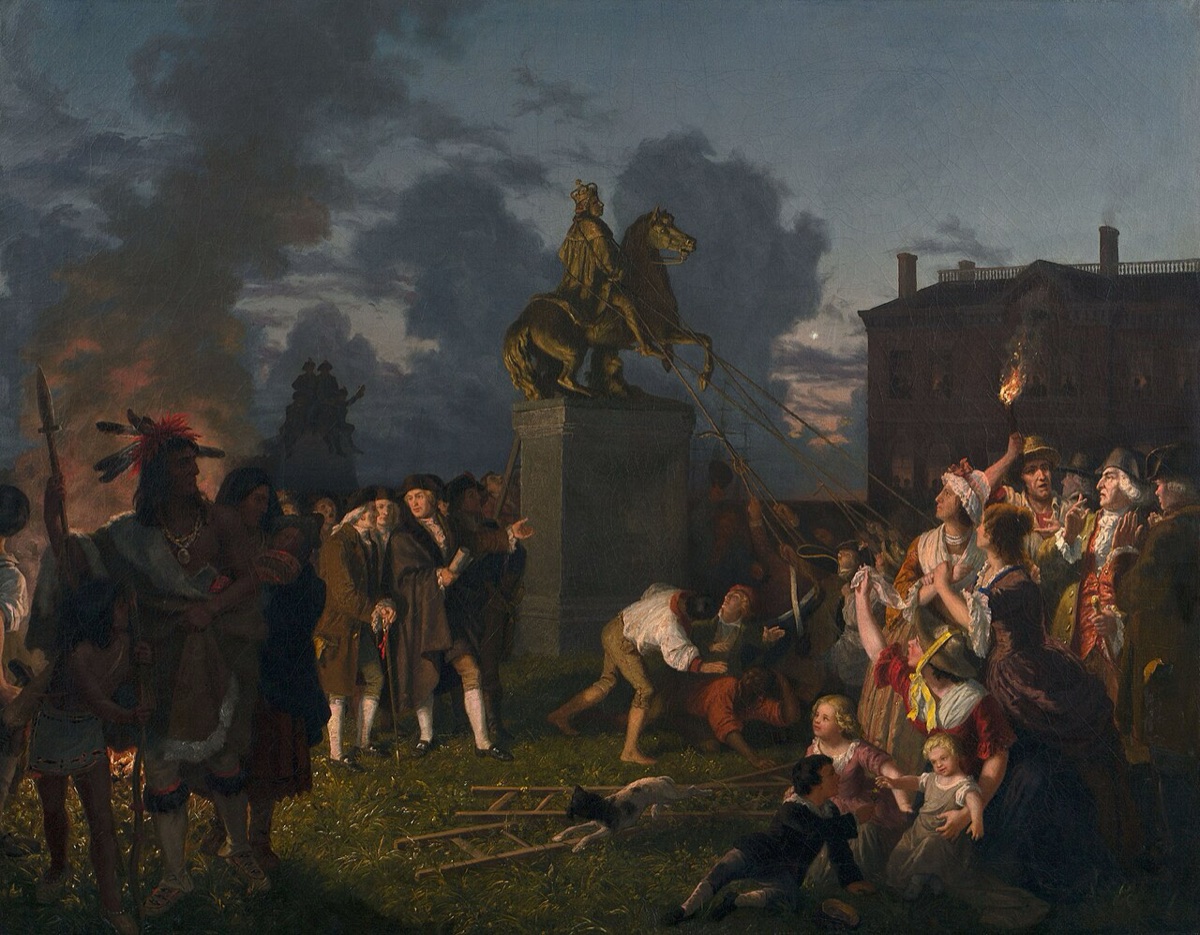
Your child is reading Chains. Isabel is in New York City in the summer of 1776, when Patriots pull down the statue of King George III, the scene in this painting. Here is what really happened that night.
The book your child may be reading
Grades 5–9 · Scott O'Dell Award for Historical Fiction
Chainsby Laurie Halse Anderson
Isabel, an enslaved girl in New York City in 1776, spies for the Patriots while hoping for a freedom the Revolution does not promise her.
What really happened (July 9, 1776)
In 1770 the British put up a gilded lead statue of King George III on horseback in Bowling Green, a small park at the bottom of Manhattan. It weighed about 4,000 pounds and showed the king dressed like a Roman emperor, to celebrate Britain's victory in the Seven Years' War.
As anger at Britain grew, the statue became a target. In 1773 the city put an iron fence around it to stop vandals; that fence still stands and is the oldest fence in New York City.
On July 9, 1776, the Declaration of Independence was read to Washington's troops in New York. That evening the local Sons of Liberty ran down Broadway to Bowling Green and pulled the statue down. They also sawed the crown-shaped tops off the fence posts; the saw marks can still be seen.
Tradition says the lead was shipped to Connecticut and melted into more than 42,000 bullets for the Patriot army. That number comes from folklore, but pieces of the statue really do survive, most of them at the New-York Historical Society.
What the painting shows
Pulling Down the Statue of King George III, N.Y.C., by Johannes Adam Simon Oertel, 1850s.
- The king on his horse stands on a tall stone base in the middle, with ropes tied to it. Men in the center pull on the ropes as it starts to tip.
- On the right, men and women raise a torch and cheer, and small children sit on the grass in front of them.
- On the left, a Native American man in a feathered headdress stands with a spear beside a group of gentlemen in three-cornered hats. Smoke and firelight fill the evening sky.
What is true
- The statue really was a king on horseback on a high base in Bowling Green, and it really was pulled down with ropes on the evening of July 9, 1776.
- It really happened right after the Declaration of Independence was read in New York, as the painting suggests.
What was changed or invented
- Oertel painted it in the 1850s, about 80 years later. The Wikimedia Commons file describes it as an imagined, romanticized version of the scene.
- The accounts used here describe soldiers and the Sons of Liberty doing the work. The calm families, small children and the Native American figures watching are the painter's choices, not things the records tell us about.
- The painting shows the toppling but not what came after: the head was carried off, then rescued by Loyalists and sent to England.
Short timeline
- Aug 21, 1770 · The statue of George III is put up in Bowling Green.
- 1773 · An iron fence goes up around it to stop vandalism.
- Jul 4, 1776 · Congress adopts the Declaration of Independence in Philadelphia.
- Jul 9, 1776 · The Declaration is read to the troops in New York; that evening the statue is pulled down.
- Late Aug 1776 · The British win the Battle of Long Island and soon take New York City, where Isabel's story continues.
Talk about it: 3 questions
For the dinner table or the classroom.
- The crowd in the painting is celebrating liberty. In Chains, Isabel is enslaved in the same city. How would she see this night differently from the people cheering?
- Why would Patriots want to destroy a statue rather than just ignore it? Can you think of statues that have been pulled down in your own lifetime?
- Oertel painted this about 80 years later. What might a painter add to a famous moment to make it more exciting, and how can you check what really happened?
Also worth reading
Grades 4–10 · Boston Globe–Horn Book Award
Abigail Adams: Witness to a Revolutionby Natalie S. Bober
A biography built from Abigail Adams's own letters, written while her husband helped declare independence.
As an Amazon Associate, ReadingList earns from qualifying purchases at no extra cost to you. Grades come from the school, state and award lists in our database.
Where this fits in school
- AP US History reading list · Period 3 (1754–1800)
Sources
More history through paintings
- The fall of Troy and the wooden horse (legend) · Legend; Troy VIIa burned about 1180 BC
- The assassination of Julius Caesar · March 15, 44 BC
- Macbeth becomes King of Scotland · August 14, 1040
- Wat Tyler meets King Richard II at Smithfield (the Peasants' Revolt) · June 15, 1381
- Columbus lands on Guanahani (San Salvador) · October 12, 1492
- The baptism of Pocahontas · 1613–1614
- The Plymouth harvest feast of 1621 · Autumn 1621
- The Salem witch trials · 1692–1693
- The Battle of Bunker Hill · June 17, 1775
- Washington crosses the Delaware and wins at Trenton · December 25–26, 1776
- The storming of the Bastille, start of the French Revolution · July 14, 1789
- The Lewis and Clark expedition reaches the Three Forks of the Missouri · July 1805
- The Underground Railroad in Indiana · 1826–1847
- The First Battle of Bull Run (First Manassas) · July 21, 1861
- Lincoln's first reading of the Emancipation Proclamation · July 22, 1862
- The Battle of Gettysburg and Pickett's Charge · July 1–3, 1863
- Settlers move west and the idea of manifest destiny · 1860s–1890s
- The sinking of the Titanic · April 14–15, 1912
- A mustard gas attack on the Western Front, World War I · August 1918
Last updated