Elementary school · AP US History
The Plymouth harvest feast of 1621: what the painting gets right
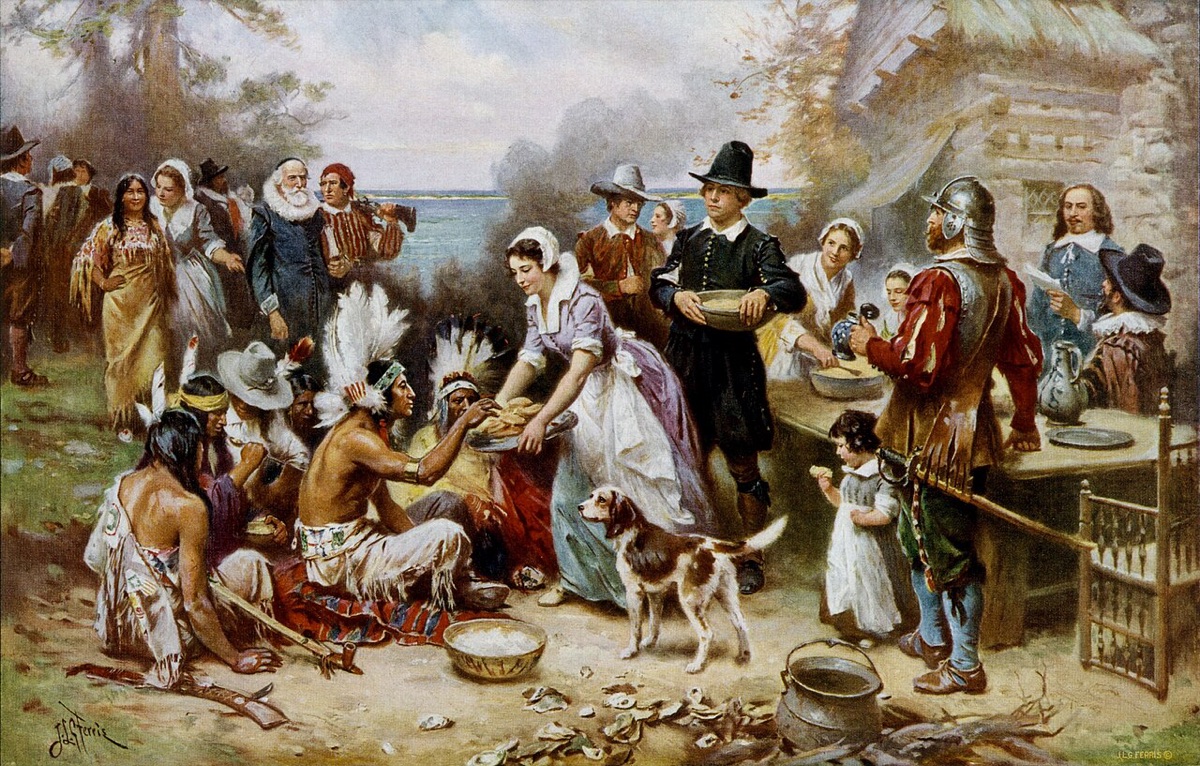
Your child is reading The Pilgrims of Plimoth. Marcia Sewall tells the Pilgrims' first years in their own plain words. This painting is the picture most Americans have of the 1621 feast, and much of it is wrong. Here is what really happened.
The book your child may be reading
Grades 4–10 · Boston Globe–Horn Book Award
The Pilgrims of Plimothby Marcia Sewall
The Pilgrims describe the crossing, the first winter and their work in the colony, in language close to their own.
What really happened (Autumn 1621)
The Mayflower reached Plymouth in late 1620 with about 102 passengers. Nearly half of them died in the first winter.
In 1621 the colony made a treaty with Massasoit, the leader of the Wampanoag, whose people had been badly hit by disease. Squanto, a Patuxet man who spoke English, lived among the colonists and helped them.
After the harvest, probably in early October, the 53 surviving colonists held a celebration. Edward Winslow wrote that Massasoit came "with some ninety men," that the feast lasted three days, and that the Wampanoag went out and killed five deer for it.
Nobody called it Thanksgiving then. The colony's first official day of thanksgiving was in 1623, and the 1621 feast was mostly forgotten until Winslow's account was found and reprinted in the 1800s.
What the painting shows
The First Thanksgiving, 1621, by Jean Leon Gerome Ferris, about 1912–1915.
- In the middle, a Pilgrim woman in a lilac dress hands a dish to Native men sitting on the ground, two of them in tall feathered headdresses.
- On the right, Pilgrim men in black hats and white collars stand at a table. A soldier in a metal helmet and armour holds a gun, and a log cabin stands behind them.
- On the left, more colonists and a Native woman stand together with the sea behind. A dog sniffs at the guests in the front.
What is true
- A harvest feast with Massasoit's men really did happen in 1621, and it went on for days.
- The armed soldier fits Winslow's account: during the feast the colonists "exercised our arms," showing off their guns.
What was changed or invented
- The tall feathered headdresses are war bonnets, worn by leaders of the Plains nations far to the west. The Wampanoag did not wear them.
- The painting has the Pilgrims serving food to Native guests seated on the ground. In the records, about 90 Wampanoag men came, outnumbering the 53 colonists, and they brought five deer to the feast.
- The log cabin is out of place. Log cabins came to North America later, probably with Finnish and Swedish settlers in New Sweden.
- Ferris painted it nearly 300 years later as part of a series of 78 scenes from American history. Art historians say his paintings mix real detail with an invented, tidy story.
Short timeline
- Sep 6, 1620 · The Mayflower leaves Plymouth, England, with 102 passengers.
- Winter 1620–21 · Nearly half of the passengers die.
- Mar 22, 1621 · Massasoit and Governor Carver make a treaty of peace; Squanto comes to live with the colonists.
- Autumn 1621 · The three-day harvest feast with Massasoit and about 90 Wampanoag men.
- 1623 · Plymouth holds its first official day of thanksgiving.
Talk about it: 3 questions
For the dinner table or the classroom.
- The Wampanoag brought five deer. Why do you think the painting shows the Pilgrims doing all the serving?
- Ferris gave the Wampanoag headdresses from a different part of the country. Where do you think he got his idea of what Native people looked like?
- Nearly half the Pilgrims had died that first winter. How might that have changed what the feast meant to the people who were there?
Also worth reading
Elementary school
1621: A New Look at Thanksgivingby Catherine O'Neill Grace and Margaret M. Bruchac
A photo book made with Plimoth Plantation that sets the familiar story beside what the records actually say.
As an Amazon Associate, ReadingList earns from qualifying purchases at no extra cost to you. Grades come from the school, state and award lists in our database.
Where this fits in school
- AP US History reading list · Period 2 (1607–1754)
Sources
More history through paintings
- The fall of Troy and the wooden horse (legend) · Legend; Troy VIIa burned about 1180 BC
- The assassination of Julius Caesar · March 15, 44 BC
- Macbeth becomes King of Scotland · August 14, 1040
- Wat Tyler meets King Richard II at Smithfield (the Peasants' Revolt) · June 15, 1381
- Columbus lands on Guanahani (San Salvador) · October 12, 1492
- The baptism of Pocahontas · 1613–1614
- The Salem witch trials · 1692–1693
- The Battle of Bunker Hill · June 17, 1775
- Washington crosses the Delaware and wins at Trenton · December 25–26, 1776
- New Yorkers pull down the king's statue after the Declaration of Independence · July 9, 1776
- The storming of the Bastille, start of the French Revolution · July 14, 1789
- The Lewis and Clark expedition reaches the Three Forks of the Missouri · July 1805
- The Underground Railroad in Indiana · 1826–1847
- The First Battle of Bull Run (First Manassas) · July 21, 1861
- Lincoln's first reading of the Emancipation Proclamation · July 22, 1862
- The Battle of Gettysburg and Pickett's Charge · July 1–3, 1863
- Settlers move west and the idea of manifest destiny · 1860s–1890s
- The sinking of the Titanic · April 14–15, 1912
- A mustard gas attack on the Western Front, World War I · August 1918
Last updated