Middle school · AP US History
Lincoln's first reading of the Emancipation Proclamation: what the painting gets right
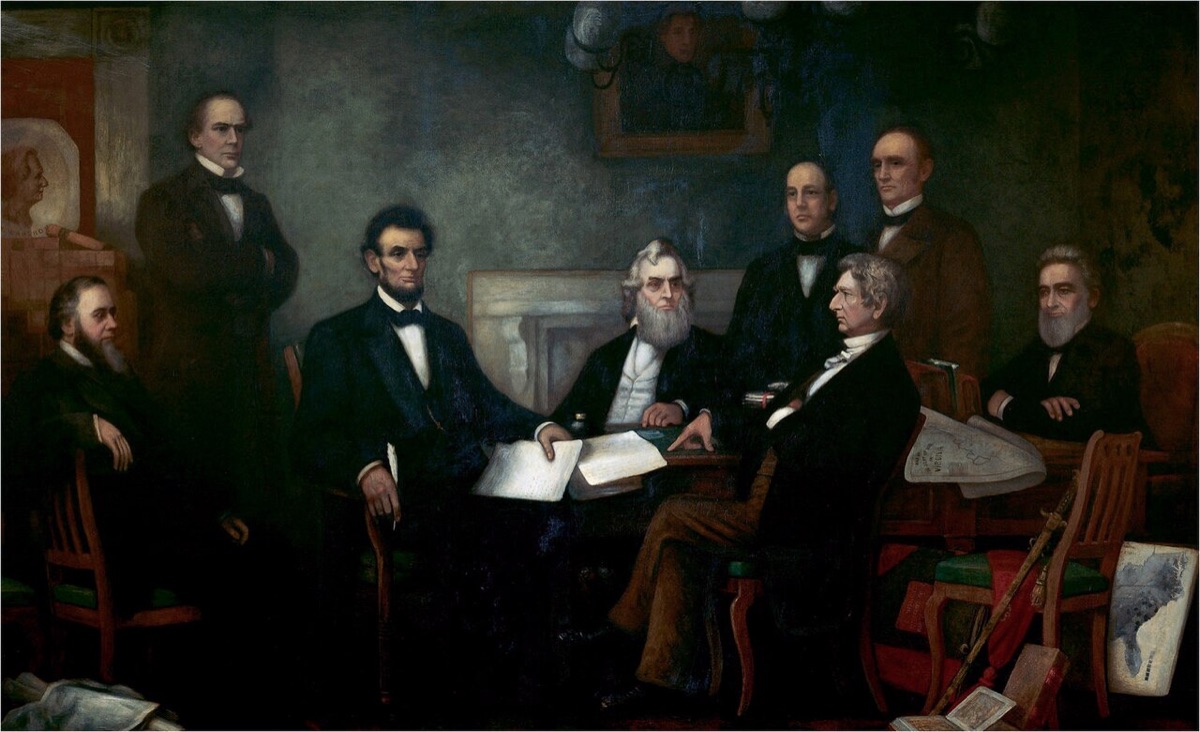
Your child is reading Lincoln: A Photobiography. This painting shows the day Lincoln first read the Emancipation Proclamation to his Cabinet. The painter lived in the White House for months to get it right, and he still arranged the room to make a point.
The book your child may be reading
Grades 3–7 · Newbery Medal
Lincoln: A Photobiographyby Russell Freedman
Lincoln's life told in real photographs, including the years of the war and the proclamation.
What really happened (July 22, 1862)
On July 22, 1862, in the middle of the Civil War, Abraham Lincoln read a draft of the Emancipation Proclamation to his Cabinet. He announced it publicly on September 22, 1862, and it took effect on January 1, 1863.
It declared free more than 3.5 million of the 4 million enslaved people in the country, those in the states in rebellion. It did not cover the nearly 500,000 enslaved people in the border states that stayed in the Union.
In Kentucky and Delaware slavery stayed legal until the Thirteenth Amendment took effect on December 18, 1865.
What the painting shows
First Reading of the Emancipation Proclamation of President Lincoln, by Francis Bicknell Carpenter, 1864.
- Lincoln sits at the head of the table holding the proclamation he has just read.
- Around him are his Cabinet, from left: Edwin Stanton (War), Salmon Chase (Treasury), Gideon Welles (Navy), Caleb Smith (Interior), William Seward (State), Montgomery Blair (Postmaster General) and Edward Bates (Attorney General).
- In the lower right corner, a map leans against a chair: an 1861 government map showing how common slavery was in each Southern county.
What is true
- Carpenter lived and worked in the White House in 1864, sketched Lincoln and the Cabinet from life, and used Mathew Brady's photographs of them.
- The room is Lincoln's real office, which was also the Cabinet Room. Today it is known as the Lincoln Bedroom.
- Lincoln himself showed Carpenter where each man had been on the day of the first reading.
What was changed or invented
- Carpenter grouped the men by politics. In his own words, Lincoln sits between the 'radical' and the 'conservative' members, closest to the radicals, with the Secretary of War in front 'symbolizing the great struggle'.
- The scene was painted two years after it happened, so it is a careful reconstruction, not a record of the moment.
- The people the proclamation was about do not appear. Enslaved people had been escaping to Union lines since the first months of the war; in May 1861 General Benjamin Butler refused to send three of them back, calling them 'contraband of war'.
Short timeline
- May 1861 · General Benjamin Butler refuses to return three people who escaped to Union lines.
- Jul 22, 1862 · Lincoln reads the draft proclamation to his Cabinet.
- Sep 22, 1862 · He announces the preliminary proclamation.
- Jan 1, 1863 · The Emancipation Proclamation takes effect.
- Jul 12, 1864 · Lincoln and the Cabinet see Carpenter's finished painting at the White House.
- Dec 18, 1865 · The Thirteenth Amendment ends slavery in every state.
Talk about it: 3 questions
For the dinner table or the classroom.
- Carpenter placed the men by their politics. Who is closest to Lincoln, and what was the painter trying to say?
- The proclamation freed people only in the states fighting the Union. Why would Lincoln leave out the border states?
- No Black Americans appear in this painting about freedom. How could a painter tell the same story and include them?
Also worth reading
Grades 4–10 · Boston Globe–Horn Book Award
The Lincolns: A Scrapbook Look at Abraham and Maryby Candace Fleming
A biography of Abraham and Mary Lincoln built from letters, photos and cartoons; good for older readers who want more.
As an Amazon Associate, ReadingList earns from qualifying purchases at no extra cost to you. Grades come from the school, state and award lists in our database.
Where this fits in school
- AP US History reading list · Period 5 (1844–1877)
Sources
More history through paintings
- The assassination of Julius Caesar · March 15, 44 BC
- The baptism of Pocahontas · 1613–1614
- The Salem witch trials · 1692–1693
- The Battle of Bunker Hill · June 17, 1775
- The storming of the Bastille, start of the French Revolution · July 14, 1789
- The Underground Railroad in Indiana · 1826–1847
- The Battle of Gettysburg and Pickett's Charge · July 1–3, 1863
- The sinking of the Titanic · April 14–15, 1912
- A mustard gas attack on the Western Front, World War I · August 1918
Last updated