High school
The assassination of Julius Caesar: what the painting gets right
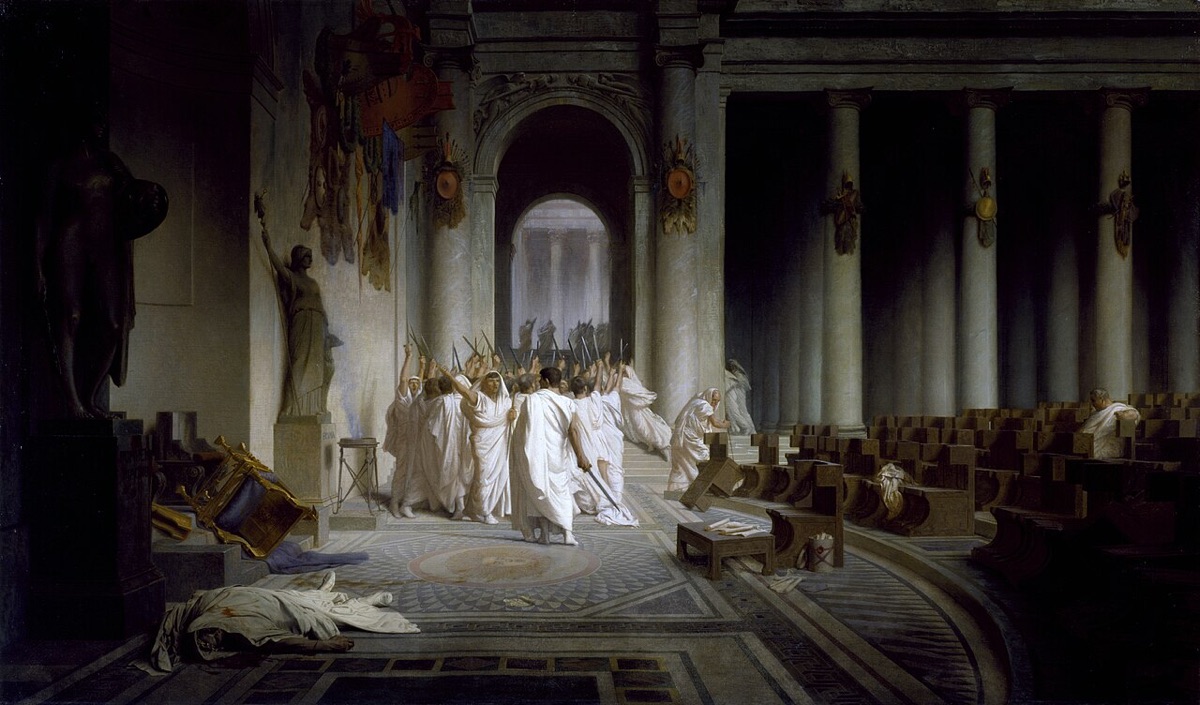
Your child is reading Julius Caesar. Gérôme painted the minute after the murder: Caesar dead on the floor, the senators who stabbed him already walking away. Here is what really happened on the Ides of March, and what Shakespeare changed for the stage.
The book your child may be reading
Grades 9–11 · Common Core lists (grade 10), Florida B.E.S.T. (grade 9) and IB English Literature
Julius Caesarby William Shakespeare
Shakespeare's play about the plot, the murder and the war that followed, built on Plutarch's Lives.
What really happened (March 15, 44 BC)
On March 15, 44 BC, the Ides of March, a group of Roman senators stabbed Julius Caesar to death at a Senate meeting in the Curia of Pompey, a hall attached to the Theatre of Pompey in Rome.
The plot was led by Marcus Brutus, Gaius Cassius and Decimus Brutus, and ancient writers put the number of conspirators at about 60. They said they were saving the Republic from a man who wanted to be king; Caesar had been made dictator for life.
Caesar was stabbed 23 times. He fell near a statue of Pompey, his old rival. A doctor who examined the body said only one wound, the second one near his ribs, was fatal.
The murder did not save the Republic. It led to another civil war, and Caesar's adopted heir Octavian later became Augustus, the first Roman emperor.
What the painting shows
The Death of Caesar, by Jean-Léon Gérôme, 1867.
- Caesar's body lies in the lower left corner under a white toga, next to his overturned golden chair and the dark statue at the edge of the room.
- The conspirators crowd toward the doorway on the right with their swords in the air, celebrating.
- One senator still sits alone on the empty benches at the far right, watching them go.
What is true
- The killing really happened at a Senate meeting in a hall built by Pompey, and Caesar fell near a statue of Pompey.
- After the murder the senators who were not in the plot ran, and the conspirators marched out through the city announcing that Rome was free. Caesar's body was left where it fell for some time before enslaved servants carried it home on a litter.
- Gérôme chose the moment after the attack rather than the stabbing itself, which keeps to what the sources describe instead of inventing the fight.
What was changed or invented
- The grand marble hall is Gérôme's own design. Nobody knows exactly what the inside of the Curia of Pompey looked like.
- Shakespeare's play moves the murder to the Capitol, for dramatic effect.
- 'Et tu, Brute?' is not a quote. Plutarch says Caesar said nothing and pulled his toga over his head when he saw Brutus. Suetonius says he said nothing, though some people claimed he said, in Greek, 'You too, child?'
Short timeline
- 49 BC · Caesar crosses the Rubicon with his army and starts a civil war against Pompey.
- Early 44 BC · Caesar is named dictator for life.
- Mar 15, 44 BC · Caesar is killed at the Curia of Pompey.
- 42 BC · Brutus and Cassius are defeated at Philippi.
- 27 BC · Octavian takes the name Augustus and rules as the first emperor.
- 1599 · Shakespeare's Julius Caesar is first performed.
Talk about it: 3 questions
For the dinner table or the classroom.
- Gérôme left out the stabbing and painted the moment after it. Why might that be more powerful than showing the attack?
- Shakespeare gives Caesar the words 'Et tu, Brute?' even though the sources say he was silent. What does the line add to the play?
- The conspirators said they were saving the Republic. Look at what happened next. Did they get what they wanted?
Also worth reading
High school
SPQR: A History of Ancient Romeby Mary Beard
A readable history of ancient Rome by the classicist Mary Beard, for older readers who want the bigger story around the murder.
As an Amazon Associate, ReadingList earns from qualifying purchases at no extra cost to you. Grades come from the school, state and award lists in our database.
Sources
More history through paintings
- The baptism of Pocahontas · 1613–1614
- The Salem witch trials · 1692–1693
- The Battle of Bunker Hill · June 17, 1775
- The storming of the Bastille, start of the French Revolution · July 14, 1789
- The Underground Railroad in Indiana · 1826–1847
- Lincoln's first reading of the Emancipation Proclamation · July 22, 1862
- The Battle of Gettysburg and Pickett's Charge · July 1–3, 1863
- The sinking of the Titanic · April 14–15, 1912
- A mustard gas attack on the Western Front, World War I · August 1918
Last updated