Elementary school
The sinking of the Titanic: what the painting gets right
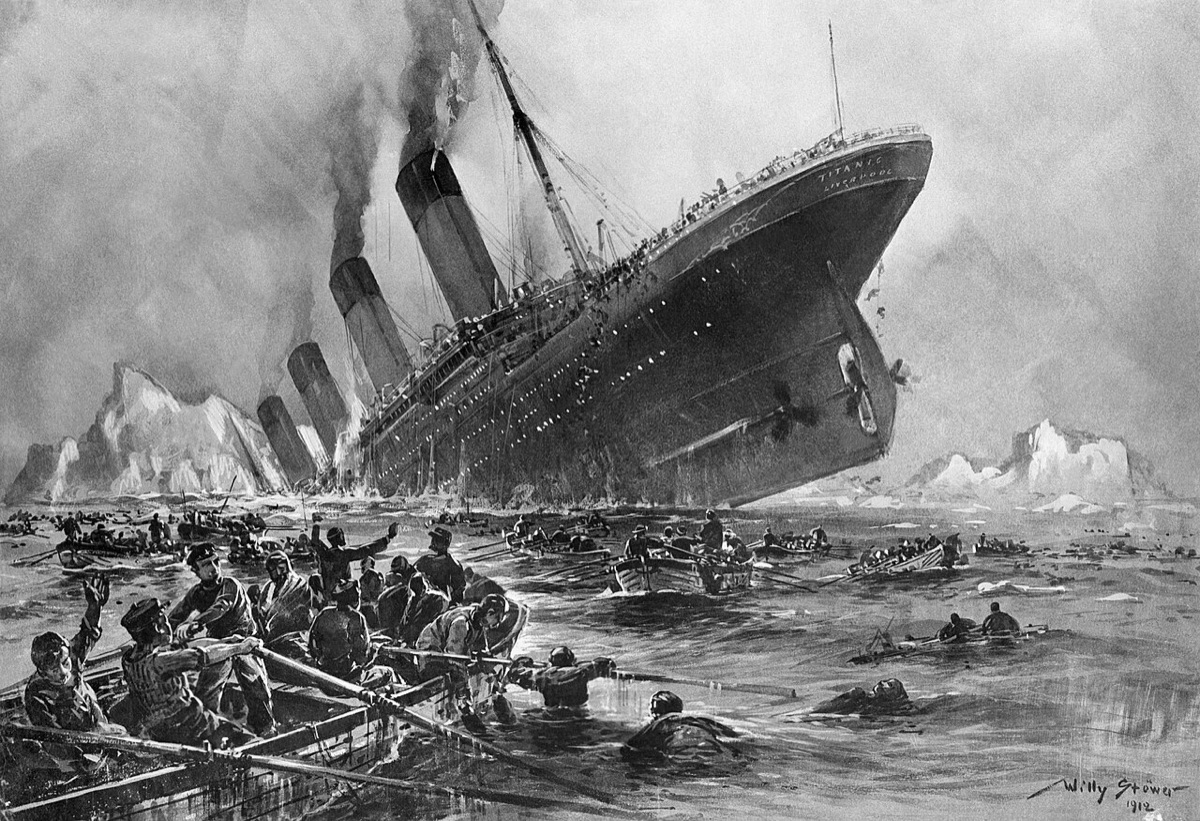
Your child is reading about the Titanic. This is one of the best-known pictures of the sinking, drawn in 1912 by a German artist who was not there. It got a lot right, and one big thing wrong that nobody could prove until 1985.
The book your child may be reading
Grades 3–5 · Virginia Readers' Choice
Exploring the Titanicby Robert D. Ballard
The story of the ship and of finding the wreck, written by Robert Ballard, who led the 1985 expedition.
Grades 4–6 · Mark Twain Readers Award (Missouri) and Nebraska Golden Sower Award
Titanic Crossingby Barbara Williams
A novel about 13-year-old Albert, who sails on the Titanic with his mother, uncle and little sister.
What really happened (April 14–15, 1912)
The Titanic, the largest ocean liner of its day, left Southampton, England for New York on its first voyage with more than 2,200 people on board.
At 11:40 p.m. on April 14, 1912, it hit an iceberg. It sank 2 hours and 40 minutes later, at 2:20 a.m., and about 1,500 people died.
The ship had 20 lifeboats with room for 1,178 people, barely half of those on board. Some boats left with empty seats. The ship Carpathia arrived about an hour and a half after the sinking and rescued the 710 survivors.
On September 1, 1985, a US-French expedition led by Robert Ballard found the wreck on the ocean floor.
What the painting shows
Untergang der Titanic (The Sinking of the Titanic), by Willy Stöwer, 1912.
- The ship tilts steeply into the water with its stern and propellers high in the air and smoke pouring from its funnels.
- In the front, a crowded lifeboat rows away while people struggle in the water.
- Icebergs rise on both sides, and more lifeboats are scattered across the sea.
What is true
- Eyewitnesses saw the stern rise high into the air as the front of the ship went under.
- Lifeboats really did row away from the ship while hundreds of people were in the freezing water.
- Drawing the ship in one piece was not a mistake by the standards of 1912: two surviving officers said so, and the British and American inquiries agreed.
What was changed or invented
- The ship broke in two before it sank. That was only proven when the wreck was found in 1985.
- Stöwer drew it soon after the disaster without detailed information. The fourth funnel was only for ventilation and did not send out black smoke.
- It was night, and the sea was flat calm. One survivor wrote that 'the sea was like glass, so smooth that the stars were clearly reflected.' Stöwer drew choppy water and a pale sky.
Short timeline
- Apr 10, 1912 · The Titanic leaves Southampton on its first voyage.
- Apr 14, 11:40 p.m. · The ship hits an iceberg.
- Apr 15, 2:20 a.m. · The Titanic sinks; about 1,500 people die.
- Apr 15, morning · The Carpathia picks up 710 survivors from the lifeboats.
- 1912 · Stöwer's picture appears in the German magazine Die Gartenlaube.
- Sep 1, 1985 · Robert Ballard's expedition finds the wreck, in two pieces.
Talk about it: 3 questions
For the dinner table or the classroom.
- Stöwer drew the ship in one piece because that is what people believed in 1912. What other 'facts' might change when new evidence turns up?
- There were only enough lifeboats for about half the people on board. Why do you think the ship sailed like that?
- The real night was dark and calm with stars on the water. Why might an artist draw rough sea and a bright sky instead?
Also worth reading
Grades 2–5
I Survived the Sinking of the Titanic, 1912by Lauren Tarshis
The first book in the I Survived series: a ten-year-old boy on board on the night it sinks. A quick, gripping start for younger readers.
Grades 9–12 · Pacific Northwest Young Reader's Choice Award
SOS Titanicby Eve Bunting
A 15-year-old sails from Ireland to America on the maiden voyage; for older readers.
As an Amazon Associate, ReadingList earns from qualifying purchases at no extra cost to you. Grades come from the school, state and award lists in our database.
Sources
More history through paintings
- The assassination of Julius Caesar · March 15, 44 BC
- The baptism of Pocahontas · 1613–1614
- The Salem witch trials · 1692–1693
- The Battle of Bunker Hill · June 17, 1775
- The storming of the Bastille, start of the French Revolution · July 14, 1789
- The Underground Railroad in Indiana · 1826–1847
- Lincoln's first reading of the Emancipation Proclamation · July 22, 1862
- The Battle of Gettysburg and Pickett's Charge · July 1–3, 1863
- A mustard gas attack on the Western Front, World War I · August 1918
Last updated