High school · AP US History
The Underground Railroad in Indiana: what the painting gets right
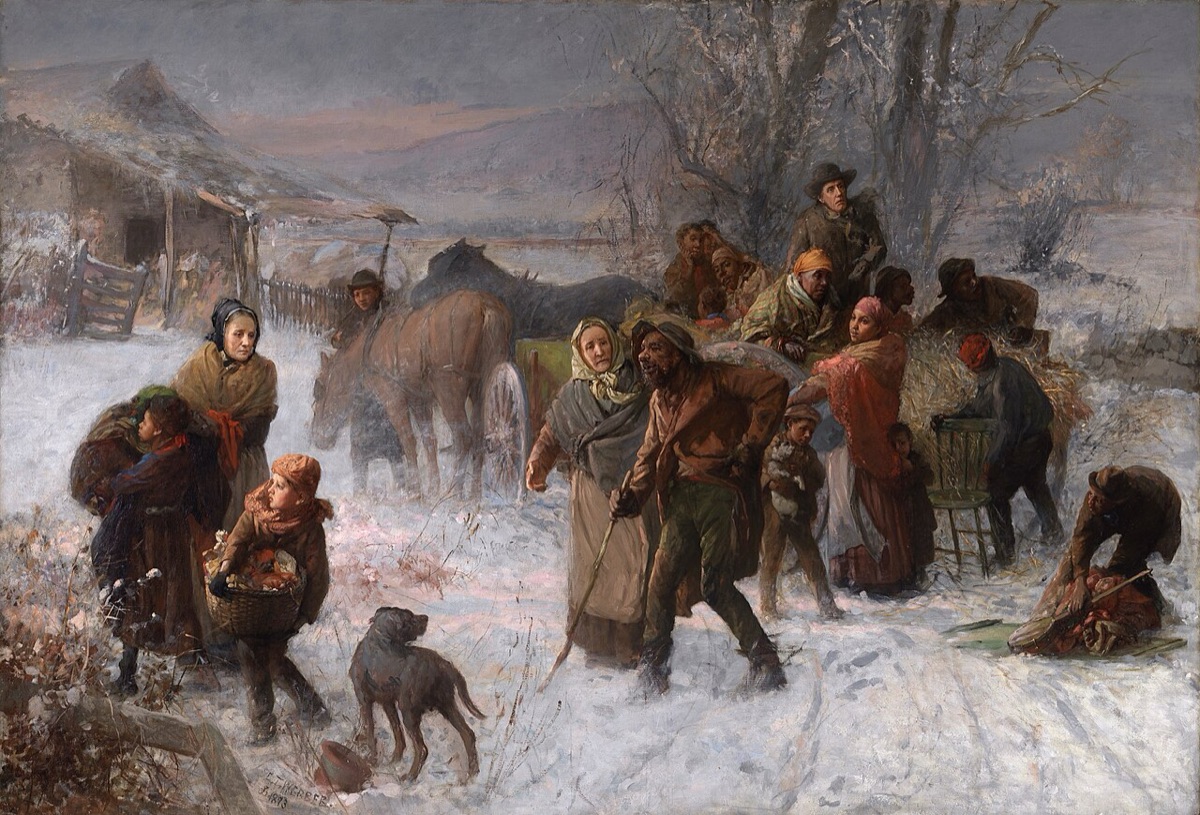
Your child is reading the Narrative of the Life of Frederick Douglass. Webber's painting is how many Americans picture the Underground Railroad: a snowy farm and kind Quakers waiting with open arms. Douglass escaped another way, and he had sharp words about how loudly some helpers talked about it.
The book your child may be reading
Grades 8–12 · Common Core lists (grade 11) and IB English Literature
Narrative of the Life of Frederick Douglass, an American Slaveby Frederick Douglass
Douglass's own account of slavery, learning to read in secret, and escaping to the North, written in 1845.
What really happened (1826–1847)
The Underground Railroad was not a railroad. It was a loose network of people, Black and white, who hid people escaping slavery and moved them north, using railway words like 'stations' and 'conductors'.
Levi Coffin, a Quaker, settled in Newport (now Fountain City), Indiana in 1826. His home became a stop, and he estimated that about 3,000 people passed through his care. In 1847 he moved to Cincinnati and kept helping from there.
A free Black community also lived near Newport and hid people too, though their hiding places were better known to slave catchers.
Frederick Douglass escaped from Baltimore on September 3, 1838, by train, dressed as a sailor and carrying papers borrowed from a free Black seaman, with help and part of the savings of Anna Murray, whom he married in New York less than two weeks later.
What the painting shows
The Underground Railroad (Fugitives Arriving at Levi Coffin's Indiana Farm), by Charles T. Webber, 1893.
- A family arrives in deep snow beside a wagon loaded with straw. A man with a walking stick leads, and others climb down from the wagon.
- Quaker women in bonnets and shawls come forward to meet them, and a white-haired man in a hat stands on the wagon.
- On the left, children carry a basket and a dog runs alongside, in front of a farmhouse and a barn.
What is true
- Levi Coffin's farm in Indiana really was one of the busiest stops, later called the Underground Railroad's 'Grand Central Station'. His house is a museum today.
- Quakers like Coffin and his wife Catherine really did shelter people. The other abolitionist in the scene, Hannah Haydock, was a real person too.
What was changed or invented
- Historians point to two stereotypes in the picture: helpless fugitives and heroic Quaker rescuers. The people escaping took by far the greatest risk, and much of the planning was their own.
- Webber painted it in 1893, almost 30 years after slavery ended. A young teacher, Wilbur Siebert, was so moved by it at a Chicago fair that he wrote a book in 1898, and the many books that followed mixed fact and legend.
- Douglass did not take this kind of route. He also criticized helpers who talked about the 'Underground Railroad' so openly that it became, in his words, the 'upperground railroad'.
Short timeline
- 1826 · Levi Coffin settles in Newport, Indiana; his home becomes a stop.
- Sep 3, 1838 · Frederick Douglass escapes from Baltimore by train.
- 1845 · Douglass publishes his Narrative.
- 1847 · Coffin moves to Cincinnati.
- 1849 · Harriet Tubman escapes from Maryland; she returns about 13 times to lead some 70 people out.
- 1893 · Webber's painting is shown at a Chicago fair.
Talk about it: 3 questions
For the dinner table or the classroom.
- Who is at the center of this painting, and who is at the edges? Who took the biggest risk in a real escape?
- Douglass escaped by train in a sailor's uniform, not in a wagon to a Quaker farm. Why might a painter in 1893 prefer the farm scene?
- Douglass called it the 'upperground railroad' when helpers talked about it too openly. Why would talking about it put people in danger?
Also worth reading
Grades 4–8 · Kentucky Bluegrass Award
Minty: A Story of Young Harriet Tubmanby Alan Schroeder
A picture book about Harriet Tubman as a girl in Maryland, before she became the Underground Railroad's best-known conductor.
Grades 11–12
The Underground Railroadby Colson Whitehead
A novel that imagines the network as a real railroad under the ground. It is fiction on purpose, and a good book to read next to the facts.
As an Amazon Associate, ReadingList earns from qualifying purchases at no extra cost to you. Grades come from the school, state and award lists in our database.
Where this fits in school
- AP US History reading list · Period 4 (1800–1848)
Sources
More history through paintings
- The assassination of Julius Caesar · March 15, 44 BC
- The baptism of Pocahontas · 1613–1614
- The Salem witch trials · 1692–1693
- The Battle of Bunker Hill · June 17, 1775
- The storming of the Bastille, start of the French Revolution · July 14, 1789
- Lincoln's first reading of the Emancipation Proclamation · July 22, 1862
- The Battle of Gettysburg and Pickett's Charge · July 1–3, 1863
- The sinking of the Titanic · April 14–15, 1912
- A mustard gas attack on the Western Front, World War I · August 1918
Last updated