Elementary school · AP US History
Settlers move west and the idea of manifest destiny: what the painting gets right
Your child is reading Sarah, Plain and Tall. Patricia MacLachlan's prairie family lives on a farm that only existed because of the great move west. This picture was sold in travel guides to sell that move. Here is what it shows, and what it leaves out.
The book your child may be reading
Grades 3–5 · Common Core lists, grades 4 and 5
Sarah, Plain and Tallby Patricia MacLachlan
A widowed prairie farmer and his two children wait to meet Sarah, the woman from Maine who answered his newspaper ad.
What really happened (1860s–1890s)
In the 1840s some Americans began to say it was the country's "manifest destiny" to spread west across the whole continent. The phrase first appeared in print in 1845.
The Homestead Act of 1862 offered free public land to families who would farm it. Over the following decades about 1.6 million homesteads were granted, most of them west of the Mississippi.
In 1869 the first railroad across the country was finished, linking the eastern rail network to the Pacific coast. Telegraph lines spread along with the tracks.
Most of that land was still home to Native nations in 1872. Settlement on this scale meant taking it from them.
What the painting shows
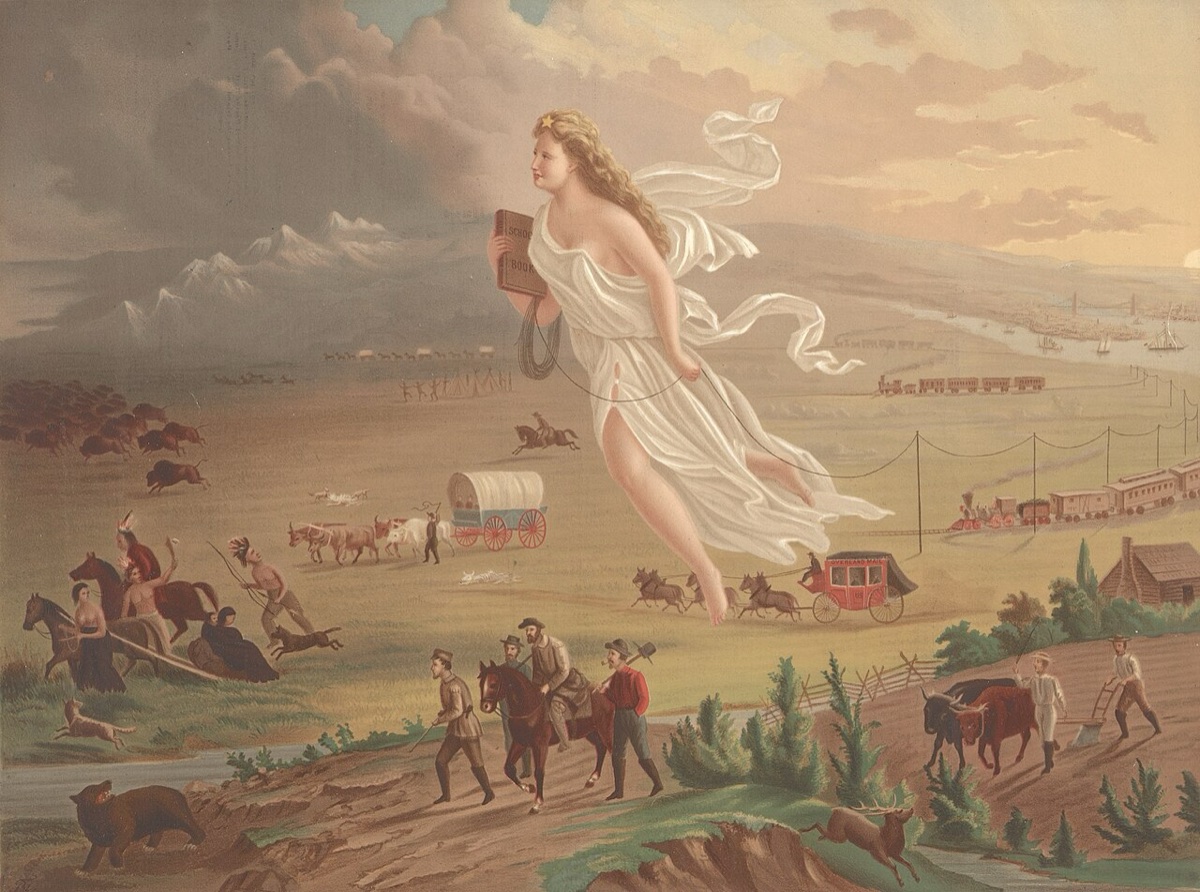
American Progress, by John Gast, 1872.
- A huge woman in a white gown floats across the middle: Columbia, a symbol of the United States, with what the publisher called "the Star of the Empire" on her head. She carries a schoolbook in one hand and strings a telegraph wire with the other.
- Below her, settlers walk west beside a covered wagon, a stagecoach and riders, with railroad trains behind them. On the right, farmers plough in front of a log cabin, and a city with ships sits on the eastern coast.
- On the far left, Native people and a herd of bison run away into dark clouds and mountains, and a bear growls at the settlers.
What is true
- The things it shows were real: wagon trains, stagecoaches, railroads and telegraph lines all moved west in these years, and homestead farms followed them.
- It is also an honest record of what many Americans believed in 1872, which is why history classes use it to teach the idea of manifest destiny.
What was changed or invented
- Nothing in it happened in one place at one time. The publisher George Crofutt ordered it in 1872 and printed copies in his travel guides to the West, to make people want to go.
- The west is painted dark and empty, as if it were waiting for settlers. In fact it was home to many Native nations, who are shown only running away.
- The picture shows progress as peaceful and certain. It leaves out the conflicts and lost land that came with it, which Indigenous artists have answered with their own versions of this picture.
Short timeline
- 1845 · The phrase "manifest destiny" first appears in print.
- 1862 · The Homestead Act offers free western land to settlers who farm it.
- 1869 · The first transcontinental railroad is finished.
- 1872 · George Crofutt commissions American Progress for his travel guides.
- Late 1800s · Prairie families like the Wittings in Sarah, Plain and Tall farm the newly settled Midwest.
Talk about it: 3 questions
For the dinner table or the classroom.
- Sarah answers a newspaper ad and leaves the sea in Maine for a prairie farm. What in this picture might have made people want to move west, and what would it not tell them?
- The Native people and bison are running into the dark. Who painted this, who paid for it, and whose side of the story does it tell?
- Columbia carries a schoolbook. Why would a picture about the West put a schoolbook in her hand?
Also worth reading
Elementary school
Little House on the Prairieby Laura Ingalls Wilder
A family settles in Kansas on land that belongs to the Osage, and has to leave; the move west seen from a covered wagon.
As an Amazon Associate, ReadingList earns from qualifying purchases at no extra cost to you. Grades come from the school, state and award lists in our database.
Where this fits in school
- AP US History reading list · Period 6 (1865–1898)
Sources
More history through paintings
- The fall of Troy and the wooden horse (legend) · Legend; Troy VIIa burned about 1180 BC
- The assassination of Julius Caesar · March 15, 44 BC
- Macbeth becomes King of Scotland · August 14, 1040
- Wat Tyler meets King Richard II at Smithfield (the Peasants' Revolt) · June 15, 1381
- Columbus lands on Guanahani (San Salvador) · October 12, 1492
- The baptism of Pocahontas · 1613–1614
- The Plymouth harvest feast of 1621 · Autumn 1621
- The Salem witch trials · 1692–1693
- The Battle of Bunker Hill · June 17, 1775
- Washington crosses the Delaware and wins at Trenton · December 25–26, 1776
- New Yorkers pull down the king's statue after the Declaration of Independence · July 9, 1776
- The storming of the Bastille, start of the French Revolution · July 14, 1789
- The Lewis and Clark expedition reaches the Three Forks of the Missouri · July 1805
- The Underground Railroad in Indiana · 1826–1847
- The First Battle of Bull Run (First Manassas) · July 21, 1861
- Lincoln's first reading of the Emancipation Proclamation · July 22, 1862
- The Battle of Gettysburg and Pickett's Charge · July 1–3, 1863
- The sinking of the Titanic · April 14–15, 1912
- A mustard gas attack on the Western Front, World War I · August 1918
Last updated