Middle school
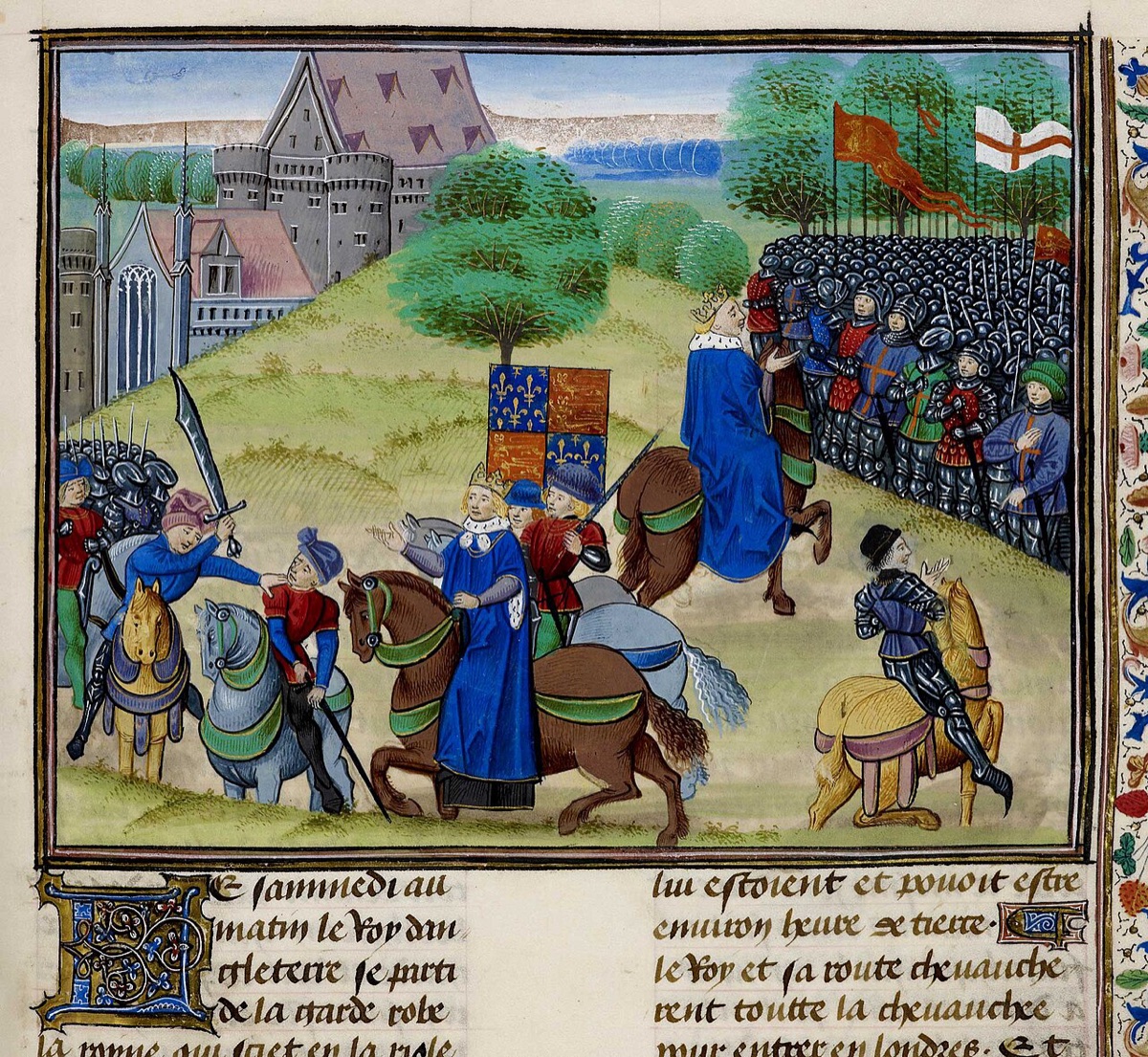
Wat Tyler meets King Richard II at Smithfield (the Peasants' Revolt): what the painting gets right
Your child is reading Crispin: The Cross of Lead. Avi's peasant boy meets John Ball, a real priest who was preparing a rebellion against the lords. Four years later that rebellion came, and this picture shows how it ended. Here is what really happened.
The book your child may be reading
Grades 3–7 · Newbery Medal
Crispin: The Cross of Leadby Avi
A peasant boy accused of a crime he did not commit flees his village in 1377 and is drawn into John Ball's secret plans for revolt.
What really happened (June 15, 1381)
After the Black Death of the 1340s killed a huge part of England's people, workers were scarce and began to demand better pay and freedom from their lords. Then the government raised a series of taxes, including a poll tax on every person over 15.
In May and June 1381 villagers in Essex and Kent rose up. Many followed John Ball, a radical priest who asked: "When Adam delved and Eve span, who was then a gentleman?" Wat Tyler became the leader of the Kentish rebels.
On June 13 the rebels entered London, burned records and killed men they blamed for the government. The next day the 14-year-old king, Richard II, met one group at Mile End and agreed to end serfdom.
On June 15 Tyler met the king at Smithfield. An argument broke out, and William Walworth, the Lord Mayor of London, struck Tyler with his sword; another of the king's men stabbed him. Richard rode to the rebels and calmed them while Walworth raised a militia. Tyler was later beheaded, the king took back his promises, and John Ball was executed a month later.
What the painting shows
The Death of Wat Tyler, by Unknown artist, in Jean Froissart's Chronicles, about 1483.
- On the left, a man in blue raises a sword against a rider in red: Mayor Walworth striking Wat Tyler.
- In the middle, the young king rides in a blue robe and gold crown, with the royal banner of England behind him.
- On the right, the king appears a second time, on a brown horse, speaking to a crowd of rebels in armour standing under flags.
What is true
- Walworth did strike Tyler at Smithfield, right in front of the king.
- Richard really did ride over to the rebels after the attack and calm them. The painter shows him twice to tell both moments in one picture.
What was changed or invented
- The rebels look like a trained army in matching armour. They were mostly farm workers and townspeople; some of the first rebels in Essex came armed with old bows and sticks.
- The picture was painted about a hundred years later, for a copy of Froissart's Chronicles. Froissart had good sources but liked to add colourful stories to the facts, and no account from the rebels' side survives.
- Tyler did not die where he fell. He rode about 30 yards, was taken to a hospital, and was then dragged back and beheaded on the mayor's order.
Short timeline
- 1377 · Crispin: The Cross of Lead takes place; new taxes begin that year to pay for the war with France.
- May 30, 1381 · A tax official arrives in Essex to collect unpaid poll tax; within days villagers drive him out.
- Jun 13, 1381 · The Kentish rebels cross London Bridge into the city.
- Jun 14, 1381 · Richard II meets rebels at Mile End and agrees to end serfdom.
- Jun 15, 1381 · Wat Tyler is struck down at Smithfield in front of the king.
- Jul 15, 1381 · John Ball is executed at St Albans; the king has already taken back his promises.
Talk about it: 3 questions
For the dinner table or the classroom.
- In Crispin, Bear and John Ball dream of a world without lords and serfs. What happened to that dream in 1381, and was any of it won?
- Every account that survives was written by people hostile to the rebels. How would a rebel have painted the same day?
- The king was only 14. Why do you think the rebels trusted him even though they hated his advisers?
Also worth reading
Grades 3–7 · Newbery Medal
The Midwife's Apprenticeby Karen Cushman
A homeless girl in a medieval English village finds a name and a trade, a close look at the lives of the poor.
Grades 4–9 · Golden Kite Award
Catherine, Called Birdyby Karen Cushman
The diary of a knight's daughter trying to avoid an arranged marriage: medieval England from the lords' side.
As an Amazon Associate, ReadingList earns from qualifying purchases at no extra cost to you. Grades come from the school, state and award lists in our database.
Sources
More history through paintings
- The fall of Troy and the wooden horse (legend) · Legend; Troy VIIa burned about 1180 BC
- The assassination of Julius Caesar · March 15, 44 BC
- Macbeth becomes King of Scotland · August 14, 1040
- Columbus lands on Guanahani (San Salvador) · October 12, 1492
- The baptism of Pocahontas · 1613–1614
- The Plymouth harvest feast of 1621 · Autumn 1621
- The Salem witch trials · 1692–1693
- The Battle of Bunker Hill · June 17, 1775
- Washington crosses the Delaware and wins at Trenton · December 25–26, 1776
- New Yorkers pull down the king's statue after the Declaration of Independence · July 9, 1776
- The storming of the Bastille, start of the French Revolution · July 14, 1789
- The Lewis and Clark expedition reaches the Three Forks of the Missouri · July 1805
- The Underground Railroad in Indiana · 1826–1847
- The First Battle of Bull Run (First Manassas) · July 21, 1861
- Lincoln's first reading of the Emancipation Proclamation · July 22, 1862
- The Battle of Gettysburg and Pickett's Charge · July 1–3, 1863
- Settlers move west and the idea of manifest destiny · 1860s–1890s
- The sinking of the Titanic · April 14–15, 1912
- A mustard gas attack on the Western Front, World War I · August 1918
Last updated