Middle school · AP US History
The Lewis and Clark expedition reaches the Three Forks of the Missouri: what the painting gets right
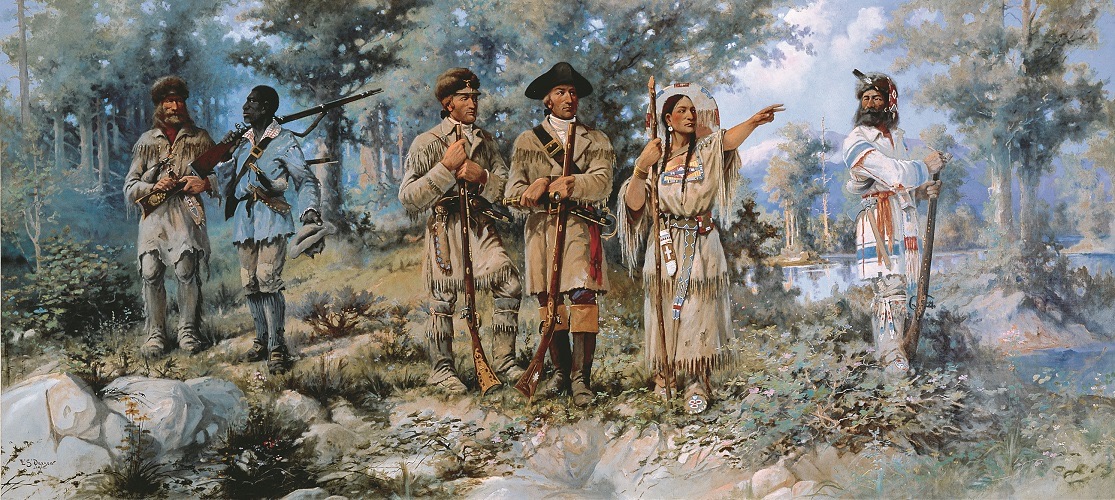
Your child is reading Streams to the River, River to the Sea. Scott O'Dell tells the Lewis and Clark journey through Sacagawea, the young Shoshone woman who traveled with it. This mural in Montana's Capitol puts her in front, pointing the way. Here is what really happened.
The book your child may be reading
Grades 6–9 · Scott O'Dell Award for Historical Fiction
Streams to the River, River to the Seaby Scott O'Dell
A novel told by Sacagawea herself, from her capture as a girl to the long trip west with her baby and a hard husband.
What really happened (July 1805)
After the Louisiana Purchase of 1803, President Thomas Jefferson sent Meriwether Lewis and William Clark to explore the new land and find a route to the Pacific. Clark set out up the Missouri on May 14, 1804.
Sacagawea joined the expedition at Fort Mandan, its winter camp of 1804–05 in present-day North Dakota, with her husband, Toussaint Charbonneau. In February 1805 she gave birth to a son, Jean Baptiste, and she carried him on her back in a cradleboard for the rest of the journey.
In late July 1805 the expedition reached the place where three rivers join to form the Missouri. Lewis named them for President Jefferson, Secretary of State James Madison and Treasury Secretary Albert Gallatin.
According to her husband's account, around 1800, when she was about 12, Sacagawea had been captured near this place in a raid by Hidatsa warriors and taken far east. Weeks later the expedition met her own Shoshone people, and their leader, Cameahwait, turned out to be her brother.
What the painting shows
Lewis and Clark at Three Forks, by Edgar S. Paxson, 1912.
- In the middle, Sacagawea in a white buckskin dress points ahead with one arm.
- Beside her stand two men in fringed buckskin, one in a fur cap and one in a three-cornered hat: the painting's Lewis and Clark.
- On the left, a bearded man in a fur cap and a Black man with a rifle stand among the trees. On the right, a man in a white coat and feathered cap leans on his rifle beside the river.
What is true
- Sacagawea really was at Three Forks with the expedition, near the place where she had been taken from her people.
- The Black man with a rifle must be York, an enslaved man owned by William Clark and the only African American on the expedition. He went the whole way to the Pacific.
- Paxson was praised for his attention to historical detail. He made his home in Montana and painted its frontier history for its courthouse and Capitol.
What was changed or invented
- Sacagawea's son, about five months old in July 1805, is nowhere in the painting.
- The pointing arm makes her the expedition's guide. The journals show her translating, as when the expedition met the Shoshone. The picture of her leading the way grew later, when women campaigning for the vote made her a symbol in the early 1900s.
- Paxson painted it in 1912, more than a hundred years after the journey, for a state Capitol. It is a monument to the event, not a record of a day.
Short timeline
- 1803 · The United States buys the Louisiana Territory from France.
- May 14, 1804 · The expedition sets out up the Missouri River.
- Feb 11, 1805 · Sacagawea's son Jean Baptiste is born at Fort Mandan.
- Late July 1805 · The expedition reaches the Three Forks; Lewis names the rivers Jefferson, Madison and Gallatin.
- Aug 1805 · The expedition meets the Shoshone; their leader Cameahwait is Sacagawea's brother.
- Sep 23, 1806 · The expedition ends its return journey and reports to Jefferson from St. Louis.
Talk about it: 3 questions
For the dinner table or the classroom.
- The painter left out Sacagawea's baby. How would the picture feel different with a five-month-old on her back?
- Sacagawea came back to the place where she had been kidnapped as a child. What might she have been thinking at Three Forks?
- York went the whole way to the Pacific, but he was enslaved. Why do you think he is standing at the edge of the painting?
Also worth reading
Grades 4–10 · Golden Kite Award
The Incredible Journey of Lewis and Clarkby Rhoda Blumberg
A clear nonfiction account of the whole expedition, from the Louisiana Purchase to the return home.
Grades 3–6 · Mountain Laurel Book Award (Pennsylvania)
Lewis and Clark and Meby Laurie Myers
Seaman, Lewis's Newfoundland dog, tells the story of the journey, a good start for younger readers.
As an Amazon Associate, ReadingList earns from qualifying purchases at no extra cost to you. Grades come from the school, state and award lists in our database.
Where this fits in school
- AP US History reading list · Period 4 (1800–1848)
Sources
More history through paintings
- The fall of Troy and the wooden horse (legend) · Legend; Troy VIIa burned about 1180 BC
- The assassination of Julius Caesar · March 15, 44 BC
- Macbeth becomes King of Scotland · August 14, 1040
- Wat Tyler meets King Richard II at Smithfield (the Peasants' Revolt) · June 15, 1381
- Columbus lands on Guanahani (San Salvador) · October 12, 1492
- The baptism of Pocahontas · 1613–1614
- The Plymouth harvest feast of 1621 · Autumn 1621
- The Salem witch trials · 1692–1693
- The Battle of Bunker Hill · June 17, 1775
- Washington crosses the Delaware and wins at Trenton · December 25–26, 1776
- New Yorkers pull down the king's statue after the Declaration of Independence · July 9, 1776
- The storming of the Bastille, start of the French Revolution · July 14, 1789
- The Underground Railroad in Indiana · 1826–1847
- The First Battle of Bull Run (First Manassas) · July 21, 1861
- Lincoln's first reading of the Emancipation Proclamation · July 22, 1862
- The Battle of Gettysburg and Pickett's Charge · July 1–3, 1863
- Settlers move west and the idea of manifest destiny · 1860s–1890s
- The sinking of the Titanic · April 14–15, 1912
- A mustard gas attack on the Western Front, World War I · August 1918
Last updated