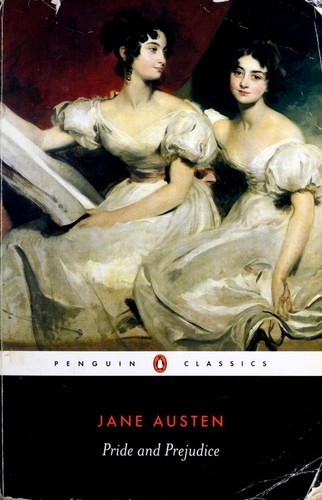
Pride and Prejudice
by Jane Austen
Audible trial: new members only. As an Amazon Associate, ReadingList earns from qualifying purchases and membership trials at no extra cost to you.
Among the most widely assigned — 7 curriculum lists
Grade placement varies by school — the median assigned book spans 4 grade levels (83% span three or more, across 13,258 source-cited assignments).
Pride and Prejudice by Jane Austen is assigned in US schools at grades 10–12, with a Lexile measure of 1100L. It appears across 7 curriculum references, sourced from state DOE pages and AP/IB/Common Core syllabi. Every citation below links to the primary source.
This page shows where Pride and Prejudice is assigned in US schools — curricula, states, grades, and the primary-source citations behind each placement. Not a summary or study guide.
- Lexile
- 1100L
- Grade range
- Grades 10–12
- Difficulty for grade
- Within the grade 9–10 band (1050–1335L)
- Age range
- Ages 14–18
- Pages
- 432
- Reading time
- about 7h 55m (est.)
- First published
- 1813
- Genre
- Literary Fiction
- ISBN-13
- 9780141439518
Reading difficulty: At 1100L, Pride and Prejudice falls within the typical 1050–1335L text-complexity range for 10th grade (Common Core Appendix A) — a grade-appropriate reading challenge.
Reading below grade level? Kids who struggle with the print version often finish the assigned book by listening — try the audiobook free with an Audible trial. Affiliate link · trial for new members.
New to these terms? What is a Lexile level? · Reading levels by grade
More formats & details
Audiobook on Amazon: Audiobook
As an Amazon Associate, ReadingList earns from qualifying purchases and membership trials at no extra cost to you. Pricing, Prime, and trial terms shown on Amazon.
About this book
Austen's comedy of manners follows Elizabeth Bennet, the second of five unmarried sisters in Regency England, as she navigates pressure to marry well and her evolving judgment of the wealthy, aloof Mr. Darcy. A core AP Literature text and a common 11th-grade British Literature assignment.
A book-club pick
Similar grade-level books
 To Kill a MockingbirdHarper Lee · 870L
 The Great GatsbyF. Scott Fitzgerald · 1070L
 Of Mice and MenJohn Steinbeck · 630L
 Lord of the FliesWilliam Golding · 770L
See all books like Pride and Prejudice→ — matched on theme + reading level.
Why widely assigned
This Literary Fiction title, reads at high-school literary complexity, typically at grades 10–12. Written in the 1810s; pairs with curriculum units on marriage and class and reputation; cited across 7 curriculum frameworks.
Themes
marriage and class · reputation · self-knowledge · pride and prejudice · gender expectations · social observation
Content notes
elopement · class-based cruelty
Common Sense Media recommends age 11+.
Where this book is assigned
AP English Literature & Composition
AQA GCSE English Literature (8702)
- required·9th gradesource: Set text in the AQA GCSE English Literature (8702) specification, component: 19th-century novel. Specification for first teaching in 2015. Read 2026-10-03.
- required·10th gradesource: Set text in the AQA GCSE English Literature (8702) specification, component: 19th-century novel. Specification for first teaching in 2015. Read 2026-10-03.
Cambridge IGCSE English Literature (0475)
- required·9th gradesource: Prescribed set text for Cambridge IGCSE Literature in English (0475), Paper 1 Section B (Prose), for examination in 2028. Transcribed from the official Cambridge International syllabus (743282-2028-2030-syllabus.pdf).
- required·9th gradesource: Prescribed set text for Cambridge IGCSE Literature in English (0475), Paper 1 Section B (Prose), for examination in 2027. Transcribed from the official Cambridge International syllabus (721333-2027-syllabus.pdf). Set texts rotate per exam year — re-verify
- required·10th gradesource: Prescribed set text for Cambridge IGCSE Literature in English (0475), Paper 1 Section B (Prose), for examination in 2028. Transcribed from the official Cambridge International syllabus (743282-2028-2030-syllabus.pdf).
- required·10th gradesource: Prescribed set text for Cambridge IGCSE Literature in English (0475), Paper 1 Section B (Prose), for examination in 2027. Transcribed from the official Cambridge International syllabus (721333-2027-syllabus.pdf). Set texts rotate per exam year — re-verify
Common Core State Standards (ELA)
IB Diploma Programme — English A: Literature
OCR GCSE English Literature (J352)
- required·9th gradesource: Set text in the OCR GCSE English Literature (J352) specification, component: 19th-century prose. Version 3.0 (November 2025). Read 2026-10-03.
- required·10th gradesource: Set text in the OCR GCSE English Literature (J352) specification, component: 19th-century prose. Version 3.0 (November 2025). Read 2026-10-03.
Show 1 more award or assignmentShow fewer
Pearson Edexcel GCSE English Literature (1ET0)
- required·9th gradesource: Set text in the Pearson Edexcel GCSE English Literature (1ET0) specification, component: 19th-century novel. Specification Issue 2, June 2019. Read 2026-10-03.
- required·10th gradesource: Set text in the Pearson Edexcel GCSE English Literature (1ET0) specification, component: 19th-century novel. Specification Issue 2, June 2019. Read 2026-10-03.
Pride and Prejudice by the numbers: pages, reading time and where it is listed, on Book Statistics.
Was this page helpful?
Common questions
- What grade level is Pride and Prejudice?
- Pride and Prejudice is most commonly assigned in US schools in grades 10–12, with a Lexile measure of 1100L. It appears on 7 school reading lists, from grade 9 to grade 12. Exact placement varies by school and district.
- What is the Lexile level of Pride and Prejudice?
- Pride and Prejudice has a Lexile measure of 1100L according to MetaMetrics. Lexile measures text complexity, not content maturity — check the grade range and content notes separately for age-appropriateness.
- How long does it take to read Pride and Prejudice?
- It takes about 7h 55m to read Pride and Prejudice (432 pages) at an average adult reading pace of about 250 words per minute — roughly 475 minutes. Faster or slower readers will vary; the estimate is a planning guide for assigning the book.
- Is Pride and Prejudice hard to read for 10th grade?
- At 1100L, Pride and Prejudice falls within the typical 1050–1335L text-complexity range for 10th grade (Common Core Appendix A) — a grade-appropriate reading challenge. Lexile measures text complexity, not thematic maturity — check the content notes for age-appropriateness separately.
- What curricula assign Pride and Prejudice?
- Pride and Prejudice appears on reading lists for AP English Literature & Composition, AQA GCSE English Literature (8702), Cambridge IGCSE English Literature (0475), and 4 others. Each assignment on this site links to its primary-source citation.
Why this book is on this list
How we classifyHide
Each dimension below is sourced from a public reference. The full framework is documented on the classification standard page.
- Lexile measure
- 1100L — sourced from MetaMetrics’ Lexile Hub.
- Grade band
- Grades 10–12 — drawn from state ELA frameworks and AP/IB syllabi citing this book.
- Curriculum alignment
- Cited in 7 curricula on this site (see “Where assigned” above for primary-source links).
- State-level evidence
- Not yet documented in a state-level framework on this site.
- Removal / banning records
- Documented as challenged or removed in 1 state per PEN America’s Index of School Book Bans — see the full banned & challenged books list.
- Seasonal / contextual tags
- Tagged for: 19th-century novel, 19th-century prose, Paper 1 Section B (Prose).