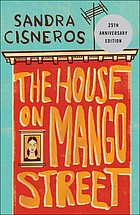
The House on Mango Street
by Sandra Cisneros
Audible trial: new members only. As an Amazon Associate, ReadingList earns from qualifying purchases and membership trials at no extra cost to you.
Assigned across 2 curriculum lists · 4 states
Grade placement varies by school — the median assigned book spans 4 grade levels (83% span three or more, across 13,258 source-cited assignments).
The House on Mango Street by Sandra Cisneros is assigned in US schools at grades 7–10, with a Lexile measure of 870L. It appears across 2 curriculum references and 4 states, sourced from state DOE pages and AP/IB/Common Core syllabi. Every citation below links to the primary source.
This page shows where The House on Mango Street is assigned in US schools — curricula, states, grades, and the primary-source citations behind each placement. Not a summary or study guide.
- Lexile
- 870L
- Grade range
- Grades 7–10
- Difficulty for grade
- Below the grade 6–8 band (925–1185L)
- Age range
- Ages 12–16
- Pages
- 110
- Reading time
- about 2 hours (est.)
- First published
- 1984
- Genre
- Coming-of-Age Fiction
- ISBN-13
- 9780679734772
Reading difficulty: At 870L, The House on Mango Street reads below the typical 925–1185L text-complexity range for 7th grade (Common Core Appendix A). It is an accessible read for the grade — often assigned for its themes and discussion value rather than for reading challenge.
Reading below grade level? Kids who struggle with the print version often finish the assigned book by listening — try the audiobook free with an Audible trial. Affiliate link · trial for new members.
New to these terms? What is a Lexile level? · Reading levels by grade
More formats & details
Other formats on Amazon: Kindle · Audiobook
As an Amazon Associate, ReadingList earns from qualifying purchases and membership trials at no extra cost to you. Pricing, Prime, and trial terms shown on Amazon.
About this book
A young Latina, Esperanza Cordero, narrates a year on Mango Street in Chicago through a series of short vignettes about family, neighbors, and her growing sense of what it means to be a woman and a writer. Cisneros's hybrid of prose and poetic form is widely assigned in middle and early high school for voice and structure analysis.
A book-club pick
Similar grade-level books
 To Kill a MockingbirdHarper Lee · 870L
 The Great GatsbyF. Scott Fitzgerald · 1070L
 Of Mice and MenJohn Steinbeck · 630L
 Lord of the FliesWilliam Golding · 770L
See all books like The House on Mango Street→ — matched on theme + reading level.
Why widely assigned
This Coming-of-Age Fiction title, reads at middle-grade prose complexity, typically at grades 7–10. Written in the 1980s; pairs with curriculum units on identity and poverty; cited across 2 curriculum frameworks.
Content notes
sexual assault (implied) · domestic violence (brief) · poverty
Common Sense Media recommends age 12+.
Where this book is assigned
Common Core State Standards (ELA)
- recommended·7th grade · New Yorksource: NY Next Gen Learning Standards grade 7 aligned reading
- recommended·7th grade · Texassource: TEKS grade 7 frequently taught text
- recommended·8th gradesource: CCSS ELA Appendix B, grades 6-8 exemplar
- recommended·8th grade · Californiasource: CA CCSS ELA grade 8 aligned reading
- required·8th grade · Illinoissource: Chicago PS grade 8 ELA core text (Chicago setting)
- recommended·9th grade · Illinoissource: Illinois Learning Standards grade 9 aligned reading
Texas Essential Knowledge and Skills (TEKS) — ELA
The House on Mango Street by the numbers: pages, reading time and where it is listed, on Book Statistics.
Was this page helpful?
Common questions
- What grade level is The House on Mango Street?
- The House on Mango Street is most commonly assigned in US schools in grades 7–10, with a Lexile measure of 870L. It appears on 2 school reading lists across 4 states, from grade 7 to grade 9. Exact placement varies by school and district.
- What is the Lexile level of The House on Mango Street?
- The House on Mango Street has a Lexile measure of 870L according to MetaMetrics. Lexile measures text complexity, not content maturity — check the grade range and content notes separately for age-appropriateness.
- How long does it take to read The House on Mango Street?
- It takes about 2 hours to read The House on Mango Street (110 pages) at an average adult reading pace of about 250 words per minute — roughly 120 minutes. Faster or slower readers will vary; the estimate is a planning guide for assigning the book.
- Is The House on Mango Street hard to read for 7th grade?
- At 870L, The House on Mango Street reads below the typical 925–1185L text-complexity range for 7th grade (Common Core Appendix A). It is an accessible read for the grade — often assigned for its themes and discussion value rather than for reading challenge. Lexile measures text complexity, not thematic maturity — check the content notes for age-appropriateness separately.
- What curricula assign The House on Mango Street?
- The House on Mango Street appears on reading lists for Common Core State Standards (ELA), Texas Essential Knowledge and Skills (TEKS) — ELA. Each assignment on this site links to its primary-source citation.
Why this book is on this list
How we classifyHide
Each dimension below is sourced from a public reference. The full framework is documented on the classification standard page.
- Lexile measure
- 870L — sourced from MetaMetrics’ Lexile Hub.
- Grade band
- Grades 7–10 — drawn from state ELA frameworks and AP/IB syllabi citing this book.
- Curriculum alignment
- Cited in 2 curricula on this site (see “Where assigned” above for primary-source links).
- State-level evidence
- Cited in 4 states ELA frameworks or DOE list (see citations above).
- Removal / banning records
- Documented as challenged or removed in 4 states per PEN America’s Index of School Book Bans — see the full banned & challenged books list.
- Seasonal / contextual tags
- No seasonal or program-specific tags on this book.